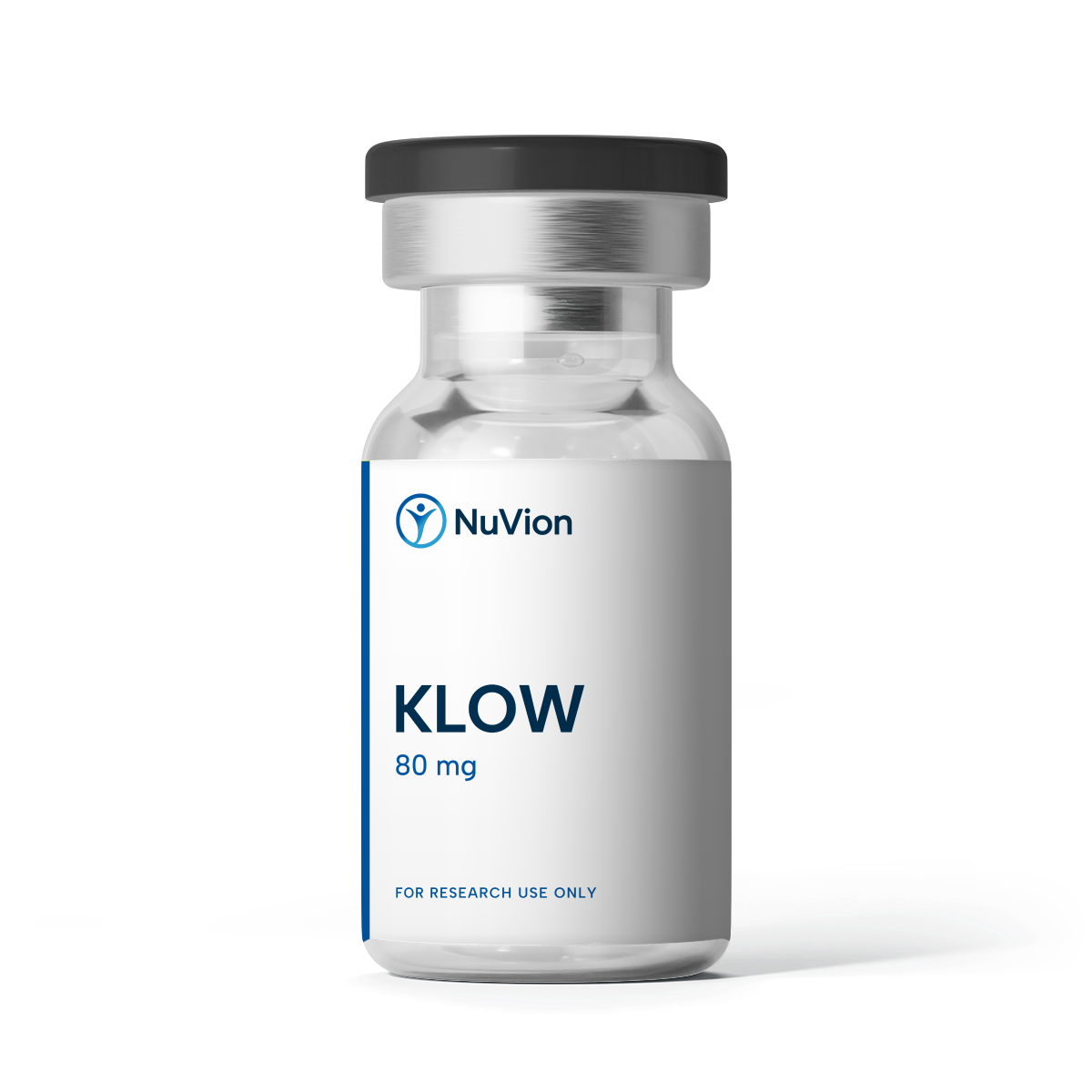

KLOW

A$179.00

KLOW, a blend of GHK-Cu, BPC-157, TB-500 and KPV studied in cell repair.

Research use only. Not for human or veterinary use.

In stock

All prices are in AUD. Ships from Australia with tracked express shipping, $15 flat, 1 to 2 business days, free on orders over $200. Research use only, not for human or veterinary use.

  • Testing status on this page
  • Same-day dispatch before 2pm
  • Dispatched from Australia
  • Card, Apple Pay & Google Pay

Research use only

Not for human or veterinary use.

Laboratory chemical

Supplied for in vitro research. We publish specifications and handling guidance only, with no protocols and no advice on use.

Not on the ARTG

Absent from the Australian Register of Therapeutic Goods and never evaluated by the TGA for safety, quality or efficacy. Absence from the register is not an approval and does not authorise any other use.

Who can order

You must be 18 or over and purchasing solely for lawful research.

What is KLOW?

KLOW is a four-peptide blend of GHK-Cu, BPC-157, TB-500 and KPV supplied in a single vial. It is used in fibroblast, endothelial and epithelial culture where several signalling pathways are examined together.

The four components are supplied together in a single 80 mg vial. GHK-Cu is a copper-binding tripeptide, BPC-157 a 15-residue synthetic peptide, TB-500 a fragment derived from thymosin beta-4, and KPV a tripeptide from alpha-melanocyte-stimulating hormone. Each is also available on its own, and each has a full profile in the research library. Because KLOW is a blend rather than a single molecule, its laboratory documentation is read component by component. What the certificate of analysis for a blend can and cannot tell you is covered in how to read a certificate of analysis.

Component What it is Sequence Why it is in the blend Full profile
GHK-Cu Tripeptide copper(II) complex Gly-His-Lys Copper-binding tripeptide studied in matrix synthesis and fibroblast models GHK-Cu
BPC-157 15-residue synthetic peptide Gly-Glu-Pro-Pro-Pro-Gly-Lys-Pro-Ala-Asp-Asp-Ala-Gly-Leu-Val Proline-rich and chemically stable in aqueous solution; studied in cell migration and adhesion assays BPC-157
TB-500 Thymosin beta-4 derived fragment Carries the Leu-Lys-Lys-Thr-Glu-Thr actin-binding motif Studied in actin dynamics and endothelial cell migration TB-500
KPV Tripeptide, residues 11 to 13 of alpha-MSH Lys-Pro-Val The C-terminal fragment of alpha-melanocyte-stimulating hormone, studied in cytokine transcription models KPV
KLOW is supplied as an 80 mg vial containing all four components. Each is a distinct molecule with its own profile, and each is available separately.
  • Four-peptide blend of GHK-Cu, BPC-157, TB-500 and KPV
  • Used in fibroblast, endothelial and epithelial culture models
  • Applied in matrix protein, cell migration and cytokine assays
  • Supplied lyophilised in a single 80mg vial

KLOW research applications

  • Scratch and transwell migration assays in fibroblasts, keratinocytes or endothelial cells, comparing KLOW with each component alone
  • Fibroblast matrix output by hydroxyproline and dye-binding collagen assays, the readout linked to the GHK-Cu component
  • NF-kB reporter assays and cytokine transcript qPCR in stimulated epithelial or macrophage lines, the KPV and GHK-Cu readout
  • G-actin to F-actin ratio and focal adhesion imaging by phalloidin and paxillin staining, for TB-500 and BPC-157

Independent test: a sample of this product was analysed by Janoshik Analytical on 2 December 2025, purity 99.87% by RP-HPLC. The certificate is shown in the lab band on this page.

Why buy KLOW from NuVion

Testing status on every page

Published results show the measured purity, the date and the certificate.

Australian stock, domestic post

Held in Australia and sent tracked in plain outer packaging.

Specifications

Storing and handling KLOW

Before reconstitution
Keep the sealed vial cool, dry and out of direct light. General practice for lyophilised peptides.
After reconstitution
Reconstitute with bacteriostatic or sterile water, store at 2 to 8°C and avoid repeated freeze-thaw cycles. No stability-tested shelf life is published for this product.

Reconstitution and storage Volumes, concentrations and storage at a glance.

KLOW reviews

5.0
★★★★★
2 reviews from verified buyers
Professional company with excellent products and outstanding service. Communication is always prompt, and delivery is fast and reliable. The whole experience has been seamless from ordering to through to delivery. Highly recommend.
Brett✓ Verified buyer
This was my first order from Nuvion. I have had 4 more orders of differing products. I am so glad I ordered, and am truly impressed with the whole client experience. Follow up on my questions, and the quality of your team, are exceptional. Nuvion understands client needs, and excels in the quality of its products and your client care. You have won me. 5 well deserved Stars.
David✓ Verified buyer

KLOW questions

Where can I buy KLOW peptide in Australia?
NuVion stocks KLOW peptide in Australia as a single 80mg vial of lyophilised powder, posted from Australian stock on a tracked express service. A sample was analysed by Janoshik Analytical on 2 December 2025, with purity of 99.87% by RP-HPLC. Bacteriostatic water is sold separately. KLOW peptide is supplied as a research material only and is not on the Australian Register of Therapeutic Goods.
How does KLOW work at the cell level?
Each component is studied through its own route. GHK-Cu carries copper into cells, BPC-157 is studied at focal adhesion and VEGFR2 signalling, TB-500 carries the actin-binding motif of thymosin beta-4, and KPV is studied for inhibition of NF-kB signalling. The KLOW research profile covers the mechanism in full.
How is KLOW resolved on RP-HPLC?
KLOW is analysed as four peaks. On a C18 gradient the components separate by hydrophobicity and size, and each is confirmed by its own molecular ion. Component masses run from about 340 to over 1,400 daltons, so one method must span the whole gradient.
Do the four KLOW components share the same chemistry?
The four components are chemically unalike. GHK-Cu is a blue copper complex, BPC-157 carries a net negative charge from its glutamate and two aspartates, and KPV is a small basic tripeptide. All four dissolve readily in water.
Why does a KLOW solution show a faint blue tint?
The tint comes from the copper complex in GHK-Cu, one of the four components. That copper can be stripped by EDTA or reduced by ascorbate and thiols, so those additives are avoided when the complex needs to stay intact.
What is in the KLOW blend?
Four peptides in one vial: GHK-Cu, BPC-157, TB-500 and KPV. Each is a distinct molecule, and each is also stocked on its own.
What is the difference between KLOW and GLOW?
GLOW is the three-peptide blend of GHK-Cu, BPC-157 and TB-500. KLOW adds KPV to the same three.
What form does KLOW arrive in?
As a lyophilised (freeze-dried) powder in a single sealed vial. Bacteriostatic water is sold separately.

Shipping, returns and wholesale orders are covered in the FAQs.

Related research peptides

NuVion Pinealon research peptide vial
20mg

Original price was: A$109.00.Current price is: A$89.00.

NuVion LL-37 research peptide vial
5mg

Original price was: A$79.00.Current price is: A$59.00.