Bacteriostatic water is sterile, non-pyrogenic water containing 0.9% (w/v) benzyl alcohol as a preservative. It is the standard diluent for reconstituting lyophilised peptides in the laboratory when a vial will be sampled more than once, because the benzyl alcohol inhibits growth of microorganisms introduced during repeated withdrawals. NuVion supplies bacteriostatic water as a laboratory consumable for in vitro research use only, alongside its range of research peptides.
Composition
| Type | Sterile aqueous diluent with preservative |
| Composition | Purified water with 0.9% w/v benzyl alcohol |
| Preservative | Benzyl alcohol, C7H8O, 108.14 g/mol |
| Buffer and salts | None; the solution is unbuffered and hypotonic |
| Supplied form | Sterile solution in a sealed, stoppered vial |
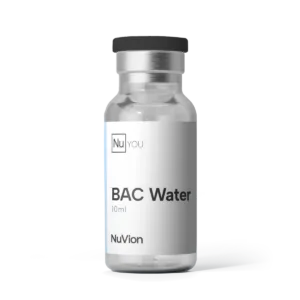
BAC Water
From $9 AUD
View productResearch use only. Not for human or veterinary use.
Why benzyl alcohol
Benzyl alcohol is an aromatic alcohol that partitions into microbial membranes, increasing their permeability and disrupting membrane-associated transport. At 0.9% it is bacteriostatic: it stops contaminating bacteria from multiplying inside the vial without being reliably bactericidal, and it has little activity against bacterial spores. That is sufficient to keep an opened vial usable for multiple withdrawals under aseptic technique. It is not a substitute for that technique.
Sterile water without preservative is chemically identical apart from the benzyl alcohol, and is handled as single-use once its stopper has been punctured. It is a reasonable alternative where a peptide will be reconstituted and used in one session. Where the solution will be drawn on over days or weeks, bacteriostatic water is the usual choice.
Reconstituting lyophilised peptides
Research peptides are supplied as a freeze-dried cake or powder in a sealed vial, usually as a trifluoroacetate or acetate salt. The required volume of bacteriostatic water is drawn from its vial with a sterile syringe and needle, then introduced slowly down the inside wall of the peptide vial so the stream does not strike the cake directly. The vial is swirled or rolled gently until the solid dissolves. Vortexing and vigorous shaking are avoided, because shear and foaming at the air-water interface can aggregate or denature peptides.
The volume added sets the concentration of the stock. A vial containing 5 mg of peptide reconstituted with 1 mL gives 5 mg/mL; with 2 mL it gives 2.5 mg/mL. The reconstitution calculator converts vial content and diluent volume into a concentration, and back again. A stock that stays cloudy is a solubility problem, addressed with pH adjustment or a co-solvent; more agitation will not help.
Compatibility notes
- Benzyl alcohol is cytotoxic to cultured mammalian cells at 0.9%. Stocks are diluted substantially into medium so the final benzyl alcohol concentration is negligible, or peptides intended for cell-based assays are reconstituted in sterile water, PBS or medium instead.
- Benzyl alcohol absorbs in the ultraviolet. It interferes with far-UV peptide quantification at 205 to 220 nm and appears as an early-eluting peak on reversed-phase HPLC, so it is included in blanks and accounted for in method development.
- At high protein concentrations benzyl alcohol is associated with aggregation of some larger proteins. Short synthetic peptides at research concentrations are generally unaffected, but a stock that turns turbid should be examined before use.
- The diluent is unbuffered, so the pH of the reconstituted solution is set by the peptide and its counter-ion. Trifluoroacetate salts give mildly acidic solutions. Where a defined pH matters, a buffer is used as the diluent.
Handling and storage
Unopened vials are kept sealed, away from light, within the temperature range on the product documentation. Once the stopper has been punctured, the vial is dated, stored as the documentation directs, and used within the in-use period given there. Each withdrawal is made with a fresh sterile syringe and needle after wiping the stopper with 70% ethanol or isopropanol. A vial showing particles, turbidity or a damaged closure is discarded.
Reconstituted peptide solutions are kept refrigerated, protected from light, and used within the period on the peptide’s documentation. Repeated freeze-thaw cycles are avoided; a stock to be held longer is divided into single-use aliquots before freezing. Syringes, needles and vial storage boxes are listed under supplies and accessories.
Frequently asked questions
What is the difference between bacteriostatic water and sterile water?
Both are sterile, non-pyrogenic water. Bacteriostatic water contains 0.9% benzyl alcohol, which inhibits microbial growth in the vial after the stopper has been punctured, so the vial can be sampled repeatedly. Sterile water has no preservative and is handled as single-use once opened.
Can bacteriostatic water be used to prepare peptides for cell culture?
Yes, provided the stock is diluted enough that the benzyl alcohol carried into the culture is negligible, and a vehicle control with the same proportion of bacteriostatic water is run alongside. Where dilution factors are small, reconstituting in sterile water, PBS or medium avoids the issue.
Is bacteriostatic water from NuVion a therapeutic good in Australia?
No. NuVion supplies it as a laboratory consumable for reconstituting research peptides for in vitro work. It is not included in the Australian Register of Therapeutic Goods, has not been assessed by the Therapeutic Goods Administration, and is not for human or veterinary use.
Research use only. This product is a laboratory chemical supplied for in vitro research. It is not included in the Australian Register of Therapeutic Goods and has not been assessed by the Therapeutic Goods Administration for quality, safety or efficacy. It is not for human or veterinary use, and nothing on this page is a representation about therapeutic use.