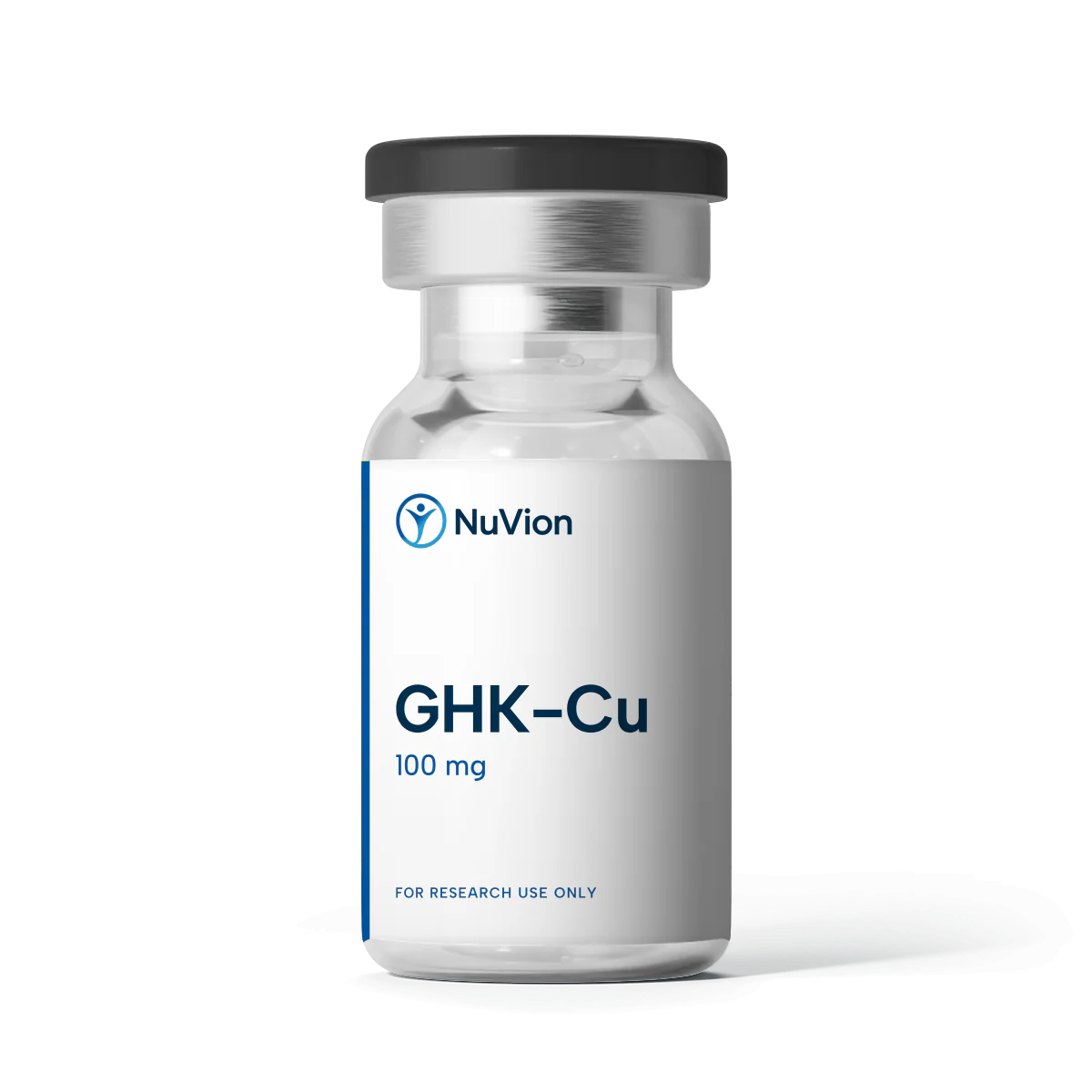
GHK-Cu is the copper(II) complex of the tripeptide glycyl-L-histidyl-L-lysine (GHK), a sequence first isolated from plasma and also present within larger extracellular matrix proteins such as the collagen alpha-2(I) chain and SPARC. It is a synthetic peptide used in copper coordination chemistry, fibroblast culture and gene expression work, where it serves as a defined, cell-permeable source of chelated copper. NuVion supplies GHK-Cu as a laboratory chemical for in vitro research use only.
Key facts
| Type/class | Synthetic tripeptide, copper(II) complex |
| Amino acid count | 3 (Gly-His-Lys) |
| Molecular formula | C14H24N6O4 (free tripeptide); C28H46CuN12O8 (2:1 tripeptide to copper complex) |
| Molecular weight | 340.4 g/mol (free tripeptide); 742.3 g/mol (2:1 complex) |
| CAS number | 49557-75-7 (GHK); 89030-95-5 (GHK-Cu) |
| Synonyms/other names | Copper tripeptide-1, prezatide copper, Cu-GHK, glycyl-L-histidyl-L-lysine copper(II) |
| Supplied form | Lyophilised powder in a sealed vial |

Structure and chemistry
GHK is a linear tripeptide with a free N-terminal amine on glycine and a free C-terminal carboxylate on lysine. Its copper chemistry comes from the first two residues. Cu(II) is held by three nitrogen donors: the glycine alpha-amino group, the deprotonated amide nitrogen of the Gly-His peptide bond and the imidazole nitrogen of histidine. This gives a square-planar coordination geometry with one site left open for a water molecule or, in the solid state, for the carboxylate of a second GHK molecule, which is why crystallographic and PubChem records describe a 2:1 peptide to copper species. The lysine side chain takes no part in coordination and stays protonated near neutral pH, so the complex carries a net positive charge.
The affinity of GHK for Cu(II) is high (a stability constant in the region of log K 16), which places it close to the N-terminal copper site of serum albumin and allows copper exchange between the two in solution. The complex is a blue to violet solid and gives a blue solution in water, whereas the copper-free tripeptide is a white powder. Copper can be stripped by strong chelators such as EDTA and can be reduced to Cu(I) by ascorbate or thiols, and the complex is more sensitive to light and to repeated freezing than the metal-free peptide. Both forms are freely water soluble, and the peptide bonds are stable in neutral aqueous solution over the timescale of a typical assay.
Mechanism of action
No dedicated cell-surface receptor for GHK has been identified. Its activity in cell models is described through two overlapping routes: delivery of copper into cells, and direct action of the tripeptide on matrix-producing cells. Copper enters cells through the CTR1 transporter after reduction to Cu(I) and is loaded onto cuproenzymes by chaperone proteins. Those enzymes include lysyl oxidase, which forms the cross-links between collagen and elastin fibrils, Cu/Zn superoxide dismutase, cytochrome c oxidase and tyrosinase. Providing copper as the GHK complex, at nanomolar to low micromolar concentration, is a way to raise intracellular copper without the cytotoxicity seen with free copper salts.
In dermal fibroblast culture, GHK-Cu increases synthesis of collagen, the glycosaminoglycans dermatan sulfate and chondroitin sulfate, and the small proteoglycan decorin. At the same time it changes matrix turnover by altering secretion of matrix metalloproteinase-2 and of the tissue inhibitors of metalloproteinases TIMP-1 and TIMP-2. The net readout in these systems is a shift in the balance between matrix deposition and matrix degradation, which is measured by hydroxyproline content, dye-binding collagen assays or ELISA for individual proteins.
GHK-Cu also acts as a chemoattractant for monocytes, macrophages, mast cells and endothelial cells in Boyden chamber and transwell assays. Gene expression profiling in cultured cell lines shows that the peptide changes transcription of a wide set of genes, with reductions in NF-kB p65 activity and increases in transcripts for antioxidant enzymes and DNA repair proteins among the reported findings. At the chemical level the complex quenches reactive aldehydes formed during lipid peroxidation, such as 4-hydroxynonenal and acrolein, and shows superoxide dismutase-like activity in cell-free assays.
Research applications
GHK-Cu sits in the Cellular Ageing category and is used in work of the following kinds.
- Fibroblast and keratinocyte culture, with readouts for collagen, glycosaminoglycan and decorin synthesis and for MMP-2, TIMP-1 and TIMP-2 secretion.
- Copper coordination studies by UV-visible spectroscopy, EPR, potentiometric titration and copper exchange experiments with albumin.
- Cell migration and chemotaxis assays with monocytes, mast cells or endothelial cells in Boyden chamber or transwell formats.
- Gene expression profiling by qPCR or RNA sequencing in cultured cells, including NF-kB reporter assays.
- Cell-free antioxidant chemistry, including aldehyde quenching and superoxide dismutase-like activity, and ROS probe measurements in cultured cells.
- Analytical method development for copper-peptide complexes by RP-HPLC, LC-MS and ICP-MS copper quantitation.
Handling in the laboratory
The lyophilised powder is reconstituted with bacteriostatic water added slowly down the side of the vial, then swirled until the solution is clear and evenly blue. The reconstitution calculator gives the volume needed to reach a chosen concentration from the vial content. If the copper complex is to be kept intact, buffers containing EDTA or citrate and reducing agents such as DTT or ascorbate should be avoided, since these either strip the copper or reduce it. Phosphate buffers at high concentration can also precipitate copper and are best replaced with HEPES or Tris for stock solutions.
Unopened vials are kept sealed, dry, away from light and refrigerated as described in the product documentation. Reconstituted solution is refrigerated and used within the period given in that documentation, with repeated freeze-thaw cycles avoided. The compound is characterised by RP-HPLC for purity and by mass spectrometry for identity, and the copper complex has a distinct chromatographic retention from the free tripeptide, which is useful when checking that the metal has stayed bound.
Testing and supply from NuVion
GHK-Cu from NuVion is made by a GMP-audited manufacturer and supplied lyophilised in sealed vials. Most batches are independently tested by Janoshik Analytical for purity by RP-HPLC and identity by mass spectrometry, and the Certificate of Analysis for a tested batch is published on the product page and in the Certificates of Analysis library. Orders are dispatched from within Australia.
Related compounds
GHK-Cu is one of the four peptides in the KLOW blend, alongside BPC-157, TB-500 and KPV, where it supplies the copper-dependent matrix arm. Other compounds in the same category include SS-31, a cardiolipin-binding tetrapeptide used in mitochondrial membrane work, and Epithalon, a tetrapeptide studied for telomerase expression in cell lines.
Frequently asked questions
What is GHK-Cu used for in research?
It is used as a defined copper-delivery peptide in fibroblast and keratinocyte culture, where collagen, glycosaminoglycan and metalloproteinase readouts are measured, and in cell-free work on copper coordination and antioxidant chemistry. It also serves as a reference chemoattractant in migration assays and as a stimulus in gene expression profiling.
How is GHK-Cu supplied?
As a lyophilised blue to violet powder in a sealed vial. Purity is determined by RP-HPLC and identity by mass spectrometry, and a Certificate of Analysis for a tested batch is available on the product page.
Is GHK-Cu a therapeutic good in Australia?
No. GHK-Cu from NuVion is a laboratory chemical for in vitro research. It is not included in the Australian Register of Therapeutic Goods and has not been assessed by the Therapeutic Goods Administration.
How should GHK-Cu be stored?
Keep the sealed vial dry, away from light and refrigerated as set out in the product documentation. Once reconstituted, keep the solution refrigerated, avoid chelating and reducing agents if the copper complex is needed intact, and use it within the period stated in the documentation.
Research use only. This product is a laboratory chemical supplied for in vitro research. It is not included in the Australian Register of Therapeutic Goods and has not been assessed by the Therapeutic Goods Administration for quality, safety or efficacy. It is not for human or veterinary use, and nothing on this page is a representation about therapeutic use.