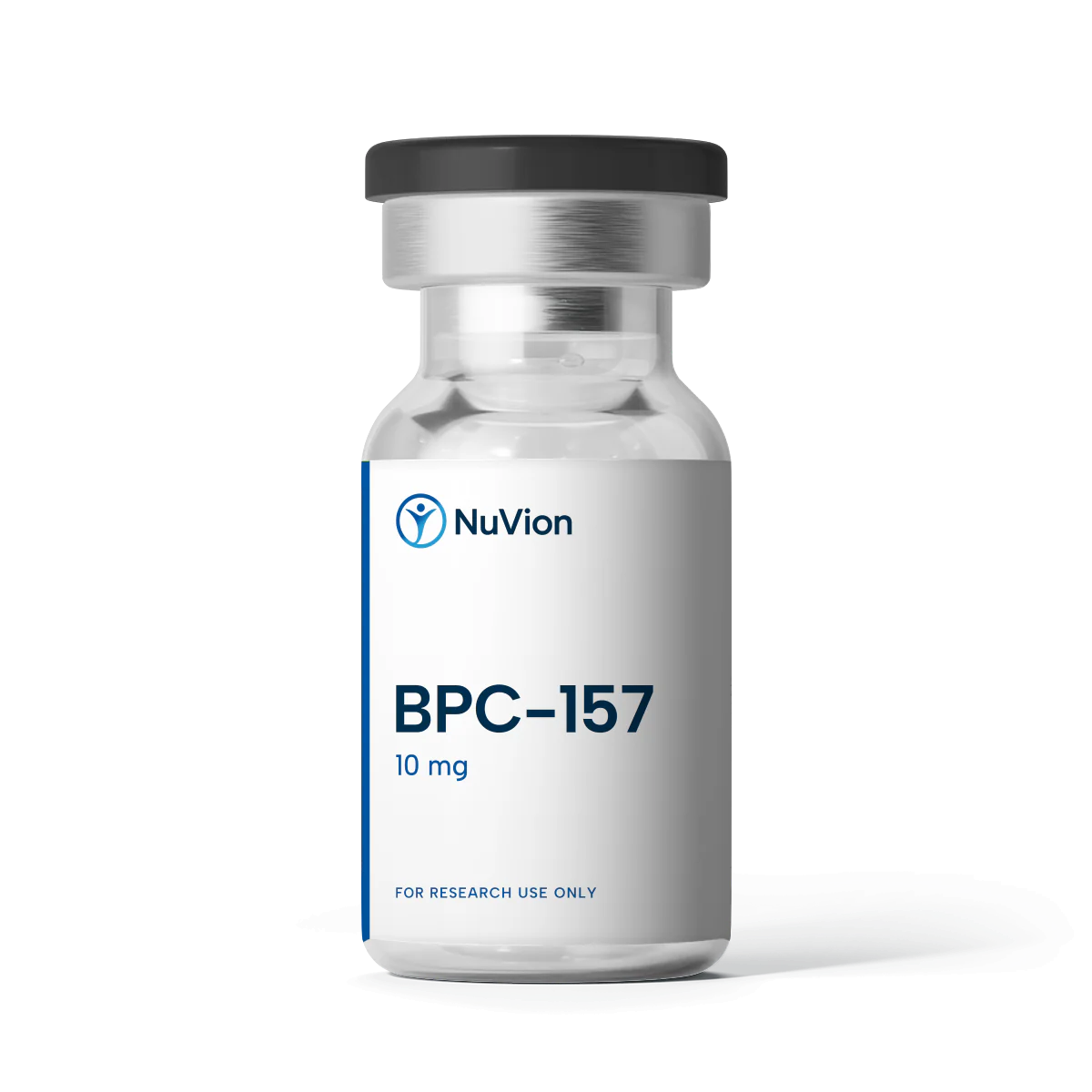
BPC-157 is a synthetic pentadecapeptide whose sequence is a fragment of a protein identified in human gastric juice. It is studied for what it does to cultured cells: migration, adhesion and spreading of fibroblasts and endothelial cells, and the focal adhesion, VEGFR2 and nitric oxide signalling that accompanies those changes. BPC-157 from NuVion is supplied as a laboratory chemical for in vitro research use only.
Key facts
| Type | Synthetic peptide, gastric protein fragment |
| Amino acid count | 15 |
| Sequence | Gly-Glu-Pro-Pro-Pro-Gly-Lys-Pro-Ala-Asp-Asp-Ala-Gly-Leu-Val |
| Molecular formula | C62H98N16O22 |
| Molecular weight | 1419.5 g/mol |
| CAS number | 137525-51-0 |
| Synonyms | Bepecin, PL 14736, Body Protection Compound 157, pentadecapeptide BPC 157 |
| Supplied form | Lyophilised powder in a sealed vial |

BPC-157
From $69 AUD
View productResearch use only. Not for human or veterinary use.
Structure and chemistry
The sequence GEPPPGKPADDAGLV is a 15-residue segment of a larger gastric protein, and the synthetic peptide is the form used in all published work. Three consecutive prolines at positions 3 to 5 and a fourth at position 8 restrict backbone rotation and give the first half of the chain polyproline character. Proline-rich segments are poor substrates for most endopeptidases, which is part of the reason the peptide is reported to persist in acidic aqueous solution for at least 24 hours, and why the literature calls it the stable gastric pentadecapeptide.
The charge balance is one lysine against one glutamate, two aspartates and the C-terminal carboxylate, so the peptide carries a net charge of about minus 2 at neutral pH and dissolves readily in water. There are no aromatic residues, so absorbance at 280 nm cannot be used for quantification and RP-HPLC methods detect at 210 to 220 nm. There is no cysteine, methionine or tryptophan, which removes the usual oxidation and disulfide concerns. The degradation route expected from the sequence is isoaspartate formation through a succinimide intermediate at the Asp-Asp-Ala segment, a slow process at neutral pH that appears on RP-HPLC as a closely eluting satellite of the main peak.
The name comes from Body Protection Compound, the label that the Zagreb group of Sikirić and Seiwerth gave to a protein fraction from human gastric juice in the early 1990s; the 15-residue synthetic fragment is the part that was taken forward. The sequence has no homology to any characterised growth factor or cytokine, and no receptor for it has been identified.
Mechanism of action
Because no receptor is known, mechanism is described from cellular assays. Four sets of observations recur in the in vitro literature.
Migration and adhesion. In cultures of tendon-derived fibroblasts, BPC-157 increased cell outgrowth from explants and transwell migration, and cells exposed to the peptide spread more quickly on culture plastic. Western blotting showed increased phosphorylation of focal adhesion kinase (FAK) and of its substrate paxillin, both of which sit at integrin-containing focal adhesions and control the turnover of adhesions that migration requires. This places the peptide upstream of the focal adhesion machinery without saying how it engages it.
Growth hormone receptor expression. The same fibroblast system showed a concentration-dependent rise in growth hormone receptor transcript and protein after peptide exposure, and cells given both peptide and growth hormone proliferated more than cells given either alone. The peptide does not bind the growth hormone receptor itself; the observation is a change in receptor expression.
VEGFR2 and nitric oxide. In human umbilical vein endothelial cells (HUVEC), BPC-157 increased expression of vascular endothelial growth factor receptor 2 (VEGFR2), its internalisation, and phosphorylation of the downstream kinase Akt and of endothelial nitric oxide synthase (eNOS), with more tube formation on basement membrane matrix. VEGFR2 knockdown or a VEGFR2 kinase inhibitor removed the response. Whether the peptide contacts VEGFR2 directly has not been established, and the current reading is that it raises receptor availability and signalling tone without acting as a VEGF mimetic.
Immediate-early gene expression. In cultured cells the peptide has been reported to induce transcription of early growth response 1 (Egr-1) and its co-repressor NAB2, a pair that forms a feedback loop over growth factor and cytokine gene expression. Egr-1 induction is a common signature of activated ERK and FAK signalling, so the four observations may share one upstream event.
Research applications
- Transwell and scratch migration assays with fibroblasts, keratinocytes and endothelial cells
- Endothelial tube formation on basement membrane matrix, with VEGFR2 knockdown or kinase inhibitor controls
- Western blotting and phospho-specific assays for FAK, paxillin, Akt and eNOS
- Nitric oxide measurement by Griess assay or NO-sensitive fluorescent probes in endothelial cultures
- qPCR and reporter assays for Egr-1, NAB2 and growth hormone receptor expression
- Stability and RP-HPLC method development in acidic buffers, using the peptide as a proline-rich, aromatic-free test analyte
BPC-157 sits in the Tissue Repair Signalling category with the other peptides used in cell migration and extracellular matrix work.
Handling in the laboratory
The lyophilised powder is reconstituted with bacteriostatic water. Run the water down the inside of the vial and let the powder dissolve without shaking; the peptide is hydrophilic and dissolves in a few minutes. The reconstitution calculator gives the concentration that a chosen water volume produces from the vial content. For cell work the stock is diluted into medium or buffer immediately before use, and the final concentration is confirmed against the peptide content stated on the Certificate of Analysis, since net peptide content is lower than gross vial weight once counter-ions and water are accounted for.
Keep the sealed vial dry, away from light and refrigerated as described in the product documentation. Once reconstituted, keep the solution refrigerated and use it within the period stated on the documentation. The peptide tolerates acidic solution well, but any peptide solution is vulnerable to microbial contamination and to repeated freeze-thaw cycles, so aliquot on the day of reconstitution. The compound is characterised by RP-HPLC for purity and by mass spectrometry for identity; on electrospray it is usually observed as the doubly charged ion near m/z 711 as well as the singly charged ion near m/z 1420.
Testing and supply from NuVion
NuVion has BPC-157 independently tested by Janoshik Analytical. Most batches are tested, and the Certificate of Analysis for a tested batch is published on the product page, reporting purity by RP-HPLC and identity by mass spectrometry. Manufacture is GMP-audited, the peptide is supplied lyophilised in sealed vials, and orders are dispatched from within Australia. Certificates for other compounds are collected in the Certificate of Analysis library.
Related compounds
BPC-157 is one of the four peptides in the KLOW blend, alongside GHK-Cu, TB-500 and KPV, where it supplies the focal adhesion and VEGFR2 arm. Two of those are used in overlapping assays on their own: TB-500, the actin-binding fragment of thymosin β4 used in cell migration and actin polymerisation work, and GHK-Cu, the copper-binding tripeptide used in fibroblast and extracellular matrix gene expression studies.
Frequently asked questions
What is BPC-157 used for in research?
BPC-157 is used as a tool compound in cell migration, adhesion and tube formation assays, and in the signalling work that goes with them: FAK and paxillin phosphorylation, VEGFR2 expression and internalisation, Akt and eNOS activation, and Egr-1 and NAB2 induction. It is also used as a test analyte in peptide stability and RP-HPLC method development because it is proline-rich, aromatic-free and stable in acid.
Does BPC-157 have a known receptor?
No. No binding protein or receptor for BPC-157 has been identified, and its sequence has no homology to characterised growth factors or cytokines. Mechanism is described from downstream readouts in cultured cells, with VEGFR2-dependent signalling in endothelial cells and FAK-dependent migration in fibroblasts the best characterised.
How is BPC-157 supplied and stored?
NuVion supplies BPC-157 as a lyophilised powder in a sealed vial. Store the sealed vial dry, away from light and refrigerated per the product documentation. After reconstitution with bacteriostatic water, keep the solution refrigerated and use it within the period given on the documentation.
Is BPC-157 a therapeutic good in Australia?
No. BPC-157 from NuVion is a laboratory chemical for in vitro research. It is not included in the Australian Register of Therapeutic Goods and has not been assessed by the TGA. It is not for human or veterinary use.
Research use only. This product is a laboratory chemical supplied for in vitro research. It is not included in the Australian Register of Therapeutic Goods and has not been assessed by the Therapeutic Goods Administration for quality, safety or efficacy. It is not for human or veterinary use, and nothing on this page is a representation about therapeutic use.