

GLOW is a research blend of three synthetic peptides: GHK-Cu, BPC-157 and TB-500. Each component acts on a different part of the machinery that fibroblasts, endothelial cells and keratinocytes use to build matrix, cross-link it and move, which is why the three are studied together in cell culture. NuVion supplies GLOW as a laboratory chemical for in vitro research use only.
Key facts
| Type/class | Synthetic peptide blend, three components |
| Components | GHK-Cu (tripeptide copper(II) complex), BPC-157 (15 residues), TB-500 (thymosin beta-4 derived) |
| Component sequences | GHK: Gly-His-Lys; BPC-157: Gly-Glu-Pro-Pro-Pro-Gly-Lys-Pro-Ala-Asp-Asp-Ala-Gly-Leu-Val; TB-500: thymosin beta-4 derived, carrying the Leu-Lys-Lys-Thr-Glu-Thr actin-binding motif |
| Component molecular weights | GHK 340.4 g/mol (free tripeptide); BPC-157 1419.5 g/mol; TB-500 889 g/mol |
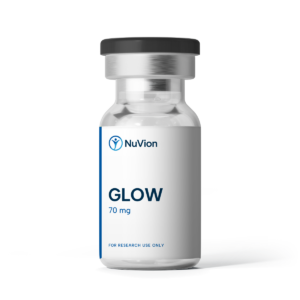
| Vial content | 70 mg total peptide |
| Synonyms/other names | GLOW blend, GHK-Cu/BPC-157/TB-500 blend |
| Supplied form | Lyophilised powder in a sealed vial |
| Analysis | Purity by RP-HPLC, identity by mass spectrometry, each component resolved as its own peak |
Structure and chemistry
The three components are chemically unalike, and that is the first thing to plan around. GHK-Cu is a tripeptide (glycyl-L-histidyl-L-lysine) holding a Cu(II) ion through its glycine amine, the Gly-His amide nitrogen and the histidine imidazole. It is blue in solution and its copper can be stripped by EDTA or reduced by ascorbate and thiols. BPC-157 is a 15-residue linear peptide whose sequence derives from a protein found in gastric juice; it is proline-rich, carries a net negative charge from its glutamate and two aspartates, and contains no methionine, cysteine or tryptophan, so it is chemically stable in aqueous solution. TB-500 is derived from thymosin beta-4, the 43-residue N-acetylated actin-sequestering protein, and contains the Leu-Lys-Lys-Thr-Glu-Thr motif that binds monomeric actin.
All three dissolve readily in water. The mixture is analysed as three peaks: on a C18 gradient the components separate by hydrophobicity and size, and each is confirmed by its own molecular ion in mass spectrometry. Because the component masses range from about 340 to over 1,400 daltons, a single RP-HPLC method covering the whole gradient is needed to see all three in one run. The copper complex also gives GHK-Cu a distinct absorbance near 620 nm, which is a quick check that the complex has survived reconstitution.
GLOW is the same base as the four-component KLOW blend without KPV. Leaving out the melanocortin-derived tripeptide removes the second input into NF-kB transcription, so the blend is weighted toward matrix output and migration, with cytokine control left out, and the analytical method has one fewer small, basic peak to resolve at the front of the gradient.
Mechanism of action
GHK-Cu acts through copper-dependent signalling. It carries copper into cells, where the metal is loaded onto lysyl oxidase, the enzyme that cross-links collagen and elastin, and onto Cu/Zn superoxide dismutase. In dermal fibroblast culture it increases collagen and glycosaminoglycan synthesis, shifts the balance of MMP-2 against TIMP-1 and TIMP-2, and reduces NF-kB p65 activity. Its contribution to the blend is the matrix side: what the cells deposit and how it is cross-linked.
TB-500 and BPC-157 both act on cell movement, by different routes. The thymosin beta-4 motif in TB-500 binds G-actin and holds it out of filaments, which changes the pool available for polymerisation at the leading edge and alters migration speed and spreading in scratch and transwell assays. BPC-157, in cultured fibroblasts and endothelial cells, increases phosphorylation of focal adhesion kinase and paxillin, reorganises the actin cytoskeleton toward a migratory phenotype, and activates VEGFR2 with downstream endothelial nitric oxide synthase signalling, measured as tube formation on basement membrane extract and nitric oxide production. One component sets the actin monomer supply and the other sets adhesion signalling, so their combination is a way to test whether migration readouts respond additively, with GHK-Cu supplying the matrix the cells move across.
Research applications
GLOW sits in the Cellular Ageing category and is used in the following kinds of work.
- Scratch and transwell migration assays with fibroblasts, keratinocytes or endothelial cells, comparing the blend with each component alone.
- Fibroblast matrix output by hydroxyproline, dye-binding collagen and glycosaminoglycan assays, with MMP-2, TIMP-1 and TIMP-2 by ELISA or zymography.
- Endothelial tube formation and VEGFR2 or eNOS phosphorylation by western blot.
- Lysyl oxidase activity and collagen cross-link assays in fibroblast-derived matrix.
- G-actin to F-actin ratio and focal adhesion imaging by phalloidin and paxillin staining.
- RP-HPLC and LC-MS method development for resolving and quantifying multi-peptide mixtures.
Handling in the laboratory
The lyophilised blend is reconstituted with bacteriostatic water added down the side of the vial and swirled until the solution is clear; a faint blue tint from the copper complex is expected. Because GHK-Cu is present, buffers containing EDTA or citrate and reducing agents such as DTT or ascorbate are avoided if the copper complex is to stay intact, and phosphate is kept low to avoid copper precipitation. The thymosin beta-4-derived component and BPC-157 adsorb to untreated plastic at low concentration, so low-binding tubes are used and working dilutions are made fresh in medium.
Unopened vials are kept sealed, dry, away from light and refrigerated as described in the product documentation. Reconstituted solution is refrigerated and used within the period given in that documentation, with freeze-thaw cycles kept to a minimum. Each component is characterised by RP-HPLC for purity and by mass spectrometry for identity.
Testing and supply from NuVion
GLOW from NuVion is supplied lyophilised in sealed vials of 70 mg total peptide. Most batches are independently tested by Janoshik Analytical for purity by RP-HPLC and identity by mass spectrometry, and the Certificate of Analysis for a tested batch is published on the product page and in the Certificates of Analysis library. Orders are dispatched from within Australia.
Related compounds
Each component has its own profile in the library: GHK-Cu for the copper and matrix arm, BPC-157 for the focal adhesion and VEGFR2 arm, and TB-500 for actin sequestration. The four-component KLOW adds KPV for work that also measures NF-kB transcription. All three components are supplied separately as single-agent controls: GHK-Cu, BPC-157 and TB-500, alongside KLOW.
Frequently asked questions
What is GLOW peptide?
GLOW is a research blend of three synthetic peptides supplied together in one vial: GHK-Cu, BPC-157 and TB-500. The name refers to the mixture, and each component is a distinct molecule with its own profile. It is used in cell culture experiments where matrix synthesis and cell migration are measured together, with the blend compared against each of its three components alone.
What is the difference between GLOW and KLOW?
KPV. GLOW contains GHK-Cu, BPC-157 and TB-500; KLOW contains the same three plus KPV, the C-terminal tripeptide of alpha-MSH studied in NF-kB transcription. GLOW is chosen when the readouts are matrix output and migration, and KLOW when cytokine transcription is also being measured. The two are analysed on the same RP-HPLC gradient, with KLOW showing one extra early peak.
How is GLOW supplied and stored?
As a lyophilised powder in a sealed vial containing all three peptides, with purity determined by RP-HPLC and identity by mass spectrometry. Keep the sealed vial dry, away from light and refrigerated as set out in the product documentation. After reconstitution, keep the solution refrigerated in a low-binding tube, avoid chelating and reducing agents, and use it within the period stated in the documentation.
Is GLOW a therapeutic good in Australia?
No. GLOW from NuVion is a laboratory chemical for in vitro research. It is not included in the Australian Register of Therapeutic Goods and has not been assessed by the Therapeutic Goods Administration.
Research use only. This product is a laboratory chemical supplied for in vitro research. It is not included in the Australian Register of Therapeutic Goods and has not been assessed by the Therapeutic Goods Administration for quality, safety or efficacy. It is not for human or veterinary use, and nothing on this page is a representation about therapeutic use.