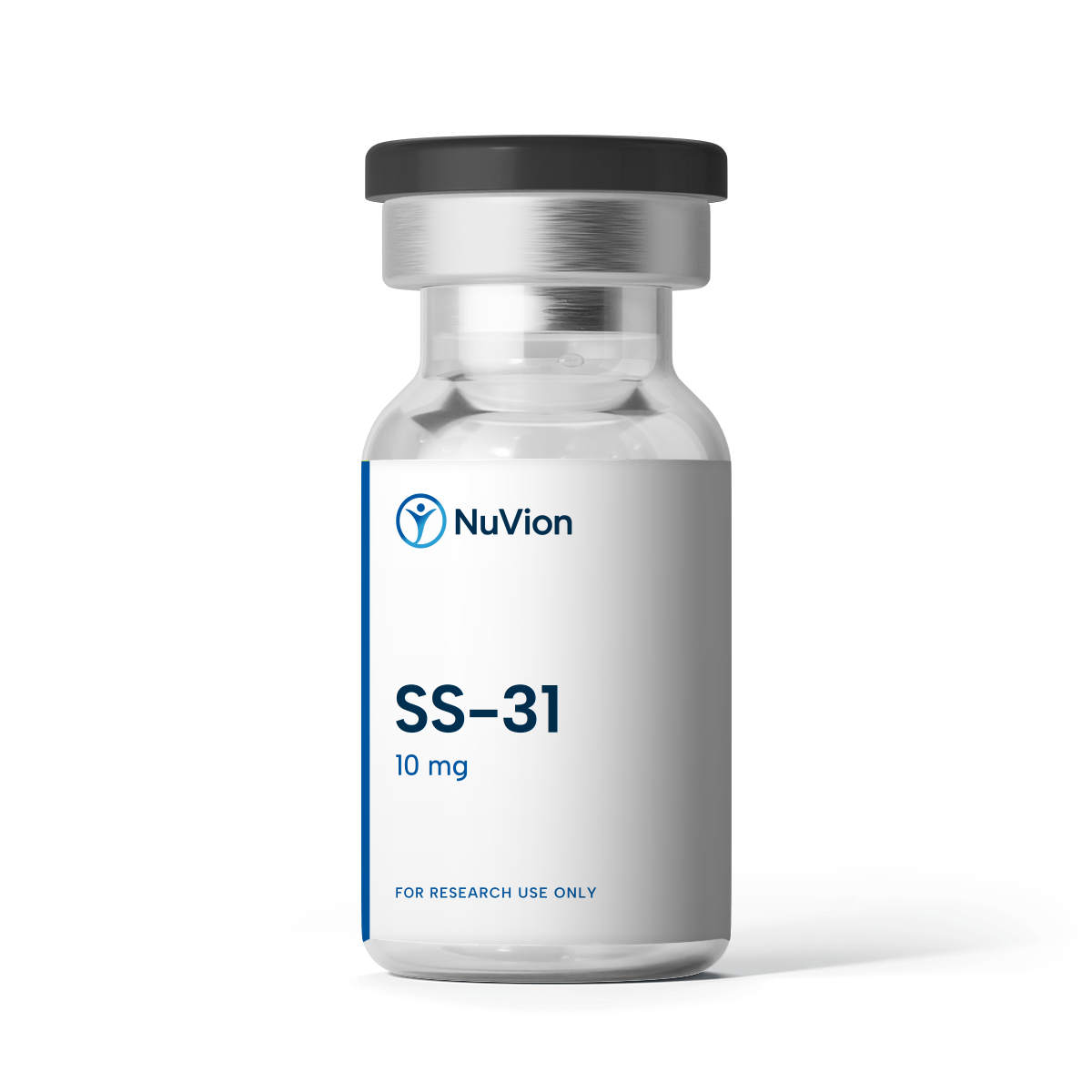

SS-31, also known as elamipretide, is a mitochondria-targeted tetrapeptide with affinity for cardiolipin in the inner mitochondrial membrane. It is used in cardiomyocyte, renal and neuronal culture to study ATP production and reactive oxygen species, and NuVion stocks it in Australia as a 10mg lyophilised vial.
- Mitochondria-targeted tetrapeptide with affinity for cardiolipin
- Used in cardiomyocyte, renal and neuronal culture models
- Applied in ATP production and reactive oxygen species assays
- Supplied lyophilised, purity by RP-HPLC and identity by mass spectrometry
SS-31 structure and research use
SS-31 has the sequence D-Arg-Dmt-Lys-Phe-NH2, where Dmt is 2′,6′-dimethyltyrosine. Its alternating aromatic and basic residues let it cross cell membranes and concentrate at the inner mitochondrial membrane, where it associates with the phospholipid cardiolipin. In the laboratory it is used in cardiomyocyte, renal and neuronal models for work on mitochondrial membrane function, ATP production and reactive oxygen species.
SS-31 research applications
- Extracellular flux analysis or high-resolution respirometry in cultured cells, permeabilised cells and isolated mitochondria
- Membrane potential by TMRM or JC-1 and mitochondrial superoxide by MitoSOX in cultured cells
- Cardiolipin-containing liposome studies by isothermal titration calorimetry, zeta potential and solid-state NMR
- Cristae morphology by electron microscopy and respiratory supercomplex assembly by blue native PAGE
SS-31 key facts
| Type | Synthetic tetrapeptide, mitochondria-targeted aromatic-cationic peptide |
|---|---|
| Amino acid count | 4, C-terminal amide |
| Sequence | D-Arg-Dmt-Lys-Phe-NH2 (Dmt = 2′,6′-dimethyl-L-tyrosine) |
| Also known as | Elamipretide, MTP-131, Bendavia, Szeto-Schiller peptide 31 |
| Vial size | 10mg, lyophilised |
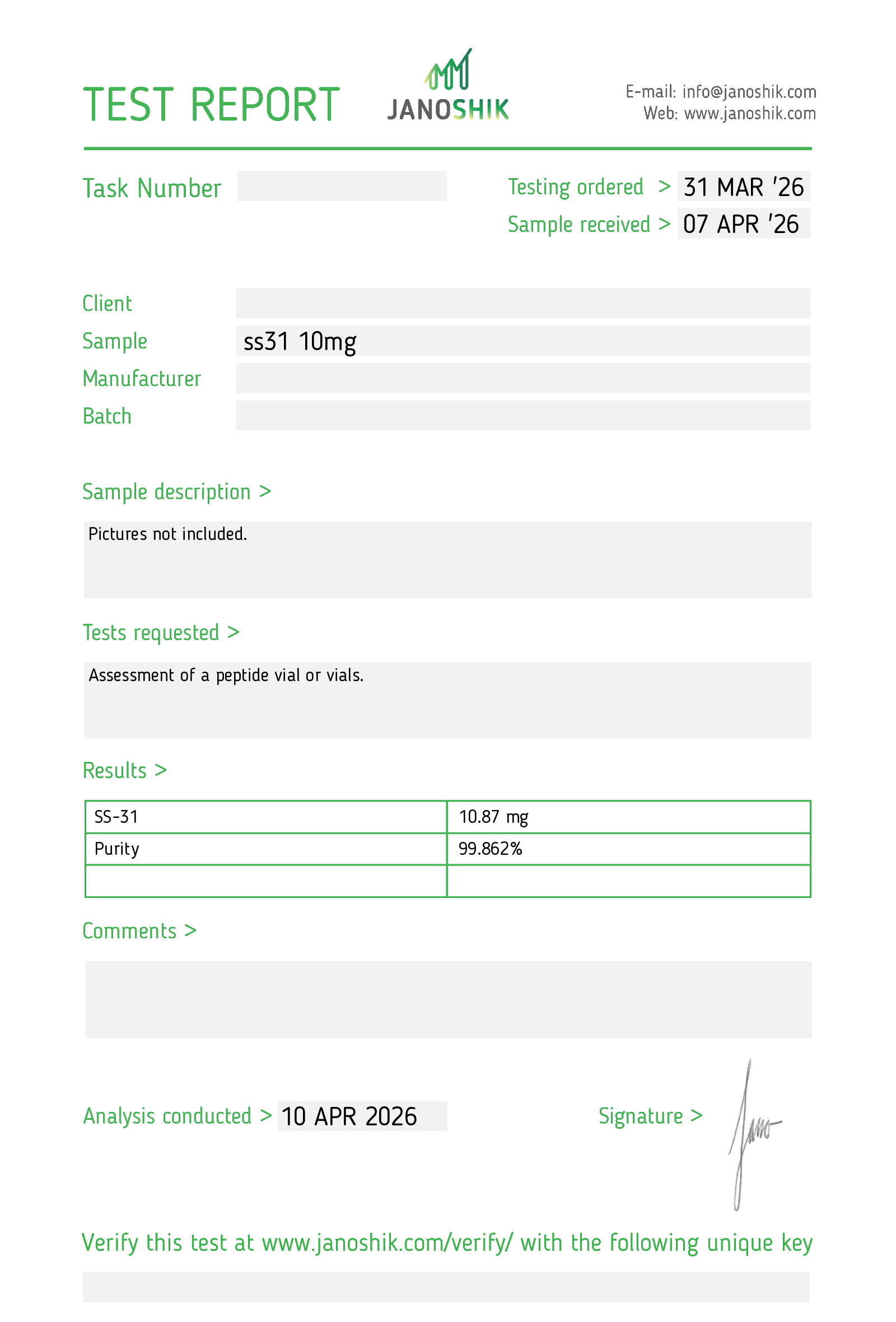
| Purity | 99.86% by RP-HPLC, Janoshik Analytical |
| Analysed | 10 April 2026 |
Research profile: SS-31: structure, mechanism and research use
Independent test: a sample of this product was analysed by Janoshik Analytical on 10 April 2026, purity 99.86% by RP-HPLC. The certificate is shown in the lab band on this page.