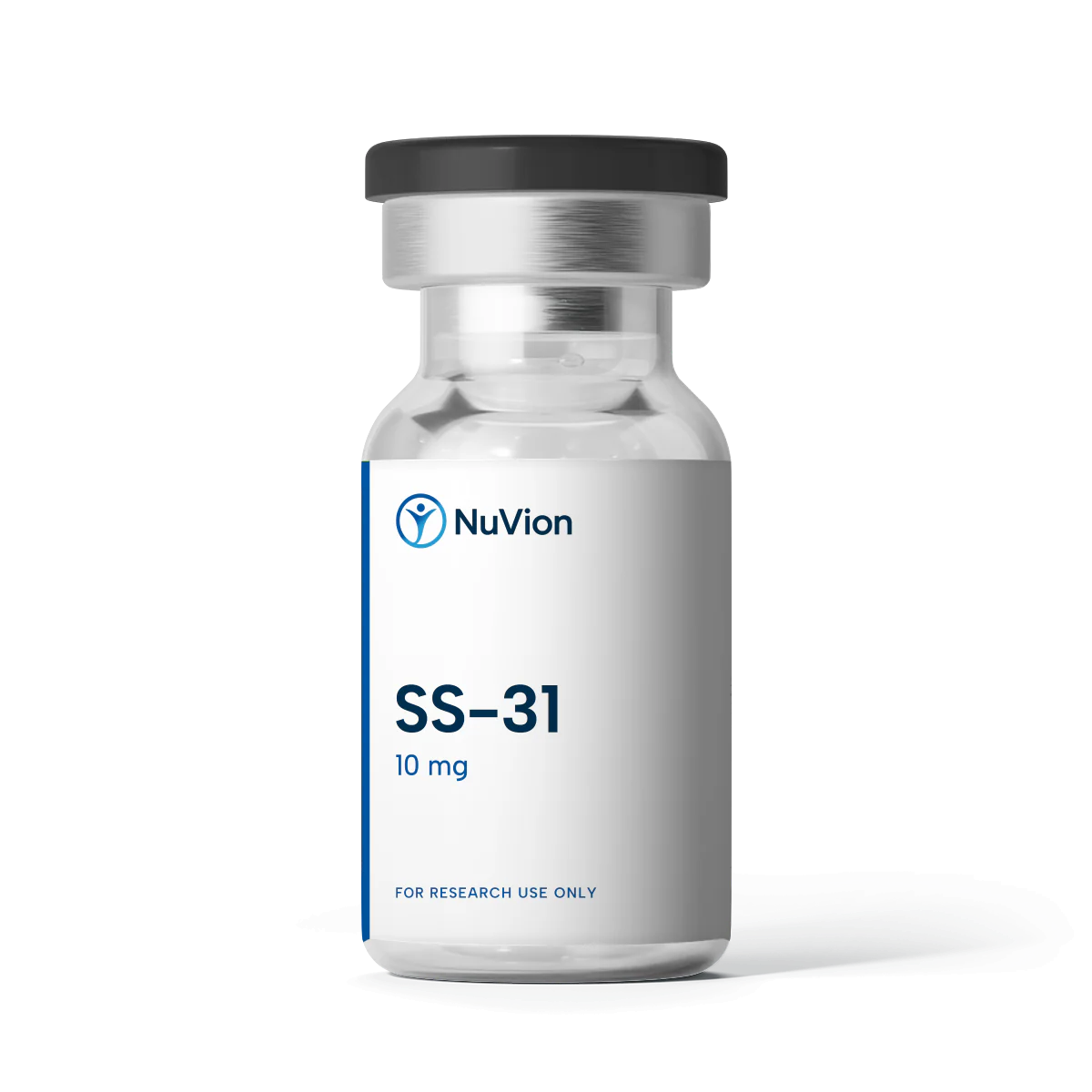
SS-31 (elamipretide, MTP-131) is a synthetic tetrapeptide with the sequence D-Arg-2′,6′-dimethyltyrosine-Lys-Phe-NH2. It belongs to the Szeto-Schiller series of aromatic-cationic peptides and is characterised by its accumulation in the inner mitochondrial membrane, where it binds the phospholipid cardiolipin. It is used in mitochondrial bioenergetics and model membrane work. NuVion supplies SS-31 as a laboratory chemical for in vitro research use only.
Key facts
| Type/class | Synthetic tetrapeptide, mitochondria-targeted aromatic-cationic peptide |
| Amino acid count | 4, C-terminal amide |
| Sequence | D-Arg-Dmt-Lys-Phe-NH2 (Dmt = 2′,6′-dimethyl-L-tyrosine) |
| Molecular formula | C32H49N9O5 |
| Molecular weight | 639.8 g/mol |
| CAS number | 736992-21-5 |
| Synonyms/other names | Elamipretide, MTP-131, Bendavia, Szeto-Schiller peptide 31 |
| Supplied form | Lyophilised powder in a sealed vial |

Structure and chemistry
SS-31 alternates cationic and aromatic residues: a D-arginine, a dimethyltyrosine, a lysine and a phenylalanine. At neutral pH the arginine guanidinium, the lysine side-chain amine and the N-terminal amine are all protonated, and because the C-terminus is an amide there is no carboxylate to offset them, so the peptide carries a net charge of +3. The two aromatic side chains give it a hydrophobic face. This alternating charge and aromaticity pattern is what drives the membrane behaviour of the whole Szeto-Schiller series, and analogues that keep the pattern share the mitochondrial uptake.
Two non-natural features matter for stability. The N-terminal residue is D-arginine, which blocks aminopeptidase cleavage, and the second residue is 2′,6′-dimethyltyrosine, a tyrosine with two methyl groups flanking the phenolic hydroxyl. The methyl groups raise the electron density of the phenol and make it a radical scavenger in cell-free assays. SS-31 is the residue-reordered analogue of SS-02 (Dmt-D-Arg-Phe-Lys-NH2); moving Dmt out of the first position removes the mu-opioid receptor affinity that SS-02 retains, which is why SS-31 is the preferred tool for mitochondrial work. The peptide is freely water soluble, contains no methionine or cysteine, and is stable in neutral aqueous solution, with the phenol the only site of slow oxidation.
Mechanism of action
SS-31 crosses the plasma membrane in a non-saturable, energy-independent manner and concentrates in mitochondria, reaching estimated inner-membrane concentrations several hundred to a thousand times those in the medium. Unlike lipophilic cations such as triphenylphosphonium conjugates, its uptake does not depend on mitochondrial membrane potential, so it accumulates in depolarised mitochondria as well as polarised ones. The target is cardiolipin, the dimeric anionic phospholipid that is largely confined to the inner membrane. Binding is electrostatic between the cationic residues and the two phosphate head groups, with the aromatic residues inserting into the acyl region of the bilayer. In model membranes this binding changes the surface electrostatics of the leaflet without disrupting the lamellar phase.
Cardiolipin does two things in the inner membrane that SS-31 affects. First, it anchors cytochrome c near complex III. When cardiolipin is oxidised or when cytochrome c binds it too tightly, the haem iron shifts into a peroxidase-competent state that oxidises cardiolipin further. SS-31 keeps cytochrome c in its electron-carrier conformation, which is measured as reduced cytochrome c peroxidase activity and lower cardiolipin peroxidation in reconstituted systems. Second, cardiolipin stabilises respiratory supercomplexes and the cristae folds that hold them. SS-31 binding is associated with preserved supercomplex assembly, tighter cristae architecture and higher oxygen consumption coupled to ATP synthesis in isolated mitochondria and permeabilised cells. Chemical cross-linking has also identified inner-membrane proteins, including the adenine nucleotide translocase and ATP synthase subunits, that sit close enough to bound SS-31 to be captured, which points to the peptide acting on lipid-protein interfaces as well as on the lipid itself.
The downstream readouts in cultured cells follow from these membrane events: lower mitochondrial superoxide as measured by MitoSOX, a more stable membrane potential by TMRM or JC-1, reduced release of cytochrome c into the cytosol, and lower activation of caspase-9 under oxidative stress. Reporter and western blot work in the same systems shows lower NF-kB and NLRP3 inflammasome activation, which sits downstream of mitochondrial ROS and cytochrome c release.
Research applications
SS-31 sits in the Cellular Ageing category and is used in the following kinds of work.
- Mitochondrial respiration by extracellular flux analysis or high-resolution respirometry in cultured cells, permeabilised cells and isolated mitochondria.
- Membrane potential and superoxide measurements with TMRM, JC-1 and MitoSOX, and ATP synthesis rate assays.
- Model membrane studies with cardiolipin-containing liposomes or monolayers by isothermal titration calorimetry, fluorescence, zeta potential and solid-state NMR.
- Cytochrome c peroxidase activity and cardiolipin peroxidation assays in reconstituted systems.
- Cristae morphology and supercomplex assembly by electron microscopy and blue native PAGE.
- Uptake and localisation with fluorescently labelled analogues, and analytical work on D-amino acid and Dmt-containing peptides by RP-HPLC and LC-MS.
Handling in the laboratory
The lyophilised peptide dissolves readily when bacteriostatic water is added down the side of the vial and the vial is swirled. The reconstitution calculator gives the volume for a chosen stock concentration from the vial content. Because the peptide is small and highly cationic it adsorbs to glass and to some plastics at low concentration, so working dilutions in the nanomolar range are made fresh in buffer or medium containing protein, and low-binding tubes are used for stocks. The stock is protected from light to limit slow oxidation of the dimethyltyrosine phenol.
Unopened vials are kept sealed, dry, away from light and refrigerated as described in the product documentation. Reconstituted solution is refrigerated and used within the period given in that documentation. The compound is characterised by RP-HPLC for purity and by mass spectrometry for identity. On C18 it elutes early because of its charge, and the expected protonated molecular ion in positive-mode electrospray sits at m/z 640.4, with a doubly charged ion at m/z 320.7.
Testing and supply from NuVion
SS-31 from NuVion is made by a GMP-audited manufacturer and supplied lyophilised in sealed vials. Most batches are independently tested by Janoshik Analytical for purity by RP-HPLC and identity by mass spectrometry, and the Certificate of Analysis for a tested batch is published on the product page and in the Certificates of Analysis library. Orders are dispatched from within Australia.
Related compounds
Compounds in the same category that are often run in the same mitochondrial assays include MOTS-c, a mitochondrially encoded peptide that activates AMPK, and NAD+, the redox coenzyme consumed by sirtuins and PARPs.
Frequently asked questions
What is SS-31 used for in research?
It is used as a cardiolipin-binding tool peptide in mitochondrial bioenergetics and in model membrane biophysics, including cytochrome c peroxidase chemistry. Typical readouts are oxygen consumption, membrane potential, mitochondrial superoxide and cristae structure in cultured cells or isolated mitochondria.
How is SS-31 supplied?
As a lyophilised powder in a sealed vial. Purity is determined by RP-HPLC and identity by mass spectrometry, and a Certificate of Analysis for a tested batch is available on the product page.
Is SS-31 a therapeutic good in Australia?
No. SS-31 from NuVion is a laboratory chemical for in vitro research. It is not included in the Australian Register of Therapeutic Goods and has not been assessed by the Therapeutic Goods Administration.
How should SS-31 be stored?
Keep the sealed vial dry, away from light and refrigerated as set out in the product documentation. After reconstitution, keep the solution refrigerated in a low-binding tube, make nanomolar working dilutions fresh, and use the stock within the period stated in the documentation.
Research use only. This product is a laboratory chemical supplied for in vitro research. It is not included in the Australian Register of Therapeutic Goods and has not been assessed by the Therapeutic Goods Administration for quality, safety or efficacy. It is not for human or veterinary use, and nothing on this page is a representation about therapeutic use.