
NAD+

A$89.00

NAD+, a redox cofactor and sirtuin and PARP substrate studied in cellular ageing.

Research use only. Not for human or veterinary use.

In stock

All prices are in AUD. Ships from Australia with tracked express shipping, $15 flat, 1 to 2 business days, free on orders over $200. Research use only, not for human or veterinary use.

  • Testing status on this page
  • Same-day dispatch before 2pm
  • Dispatched from Australia
  • Card, Apple Pay & Google Pay

Research use only

Not for human or veterinary use.

Laboratory chemical

Supplied for in vitro research. We publish specifications and handling guidance only, with no protocols and no advice on use.

Not on the ARTG

Absent from the Australian Register of Therapeutic Goods and never evaluated by the TGA for safety, quality or efficacy. Absence from the register is not an approval and does not authorise any other use.

Who can order

You must be 18 or over and purchasing solely for lawful research.

What is NAD+?

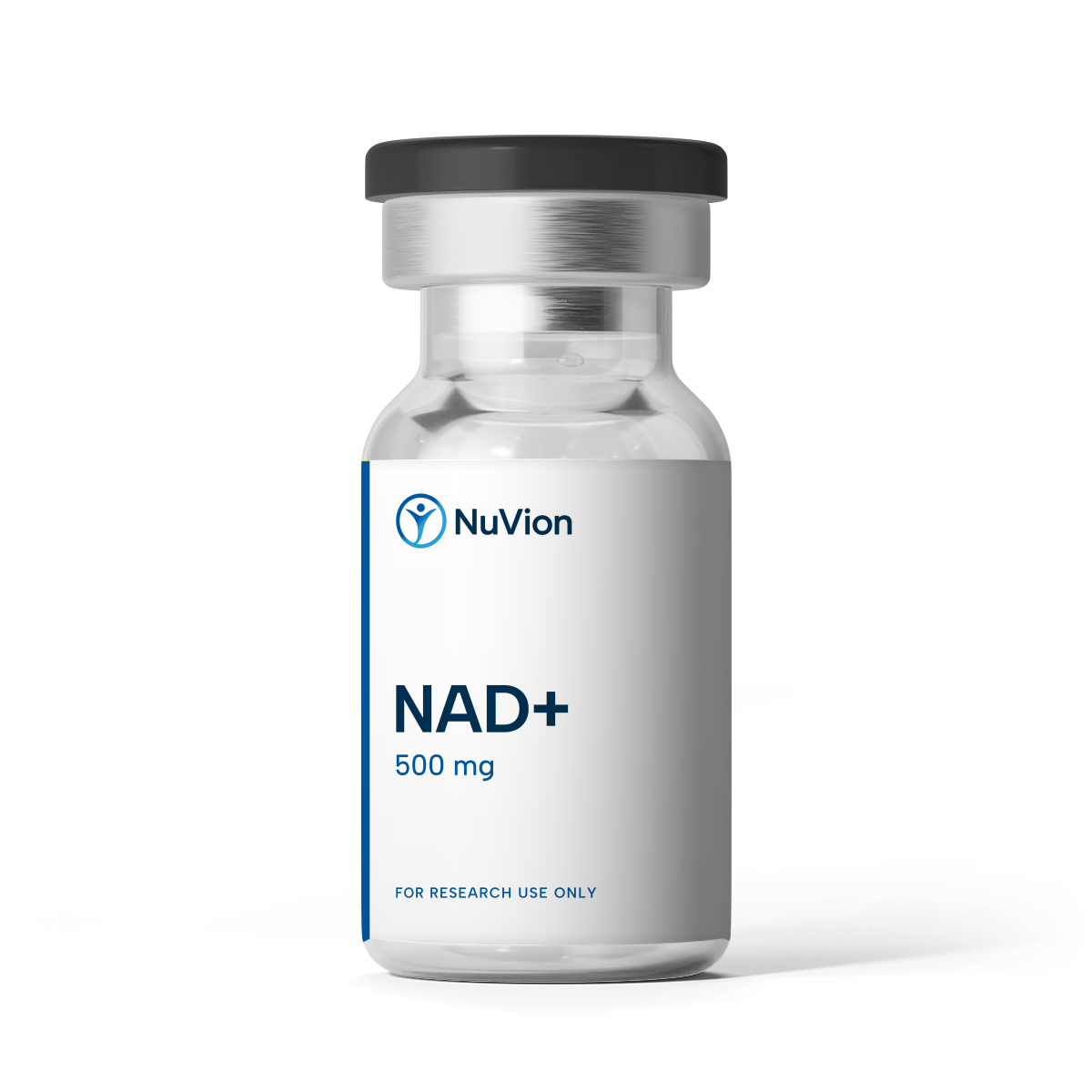
NAD+ is nicotinamide adenine dinucleotide, a redox cofactor central to cellular metabolism and the substrate for the sirtuin and PARP enzyme families. It is used in hepatocyte, myotube and neuronal culture to study NAD/NADH ratio, sirtuin activity and DNA repair, and NuVion stocks it in Australia as a 500mg lyophilised vial.

  • Nicotinamide adenine dinucleotide, a redox cofactor central to cell metabolism
  • Substrate for the sirtuin and PARP enzyme families
  • Applied in NAD/NADH ratio, sirtuin activity and DNA repair assays
  • Supplied lyophilised, purity by RP-HPLC and identity by mass spectrometry

NAD+ structure and research use

NAD+ is built from two nucleotides, one carrying nicotinamide and one carrying adenine, joined through their phosphate groups. It cycles between an oxidised form, NAD+, and a reduced form, NADH, as it carries electrons between metabolic reactions, and it is consumed as a substrate by sirtuins and PARPs. In the laboratory it is used in hepatocyte, myotube and neuronal models for work on redox balance, sirtuin activity and DNA repair signalling.

NAD+ research applications

  • Coupled spectrophotometric assays following absorbance at 340 nm to measure dehydrogenase kinetics and Km
  • Sirtuin deacylase activity assays with fluorogenic peptide substrates and nicotinamide product inhibition studies
  • PARP activity assays and characterisation of ADP-ribosylated proteins in cell lysates
  • Calibration curve and retention time reference for ion-pairing HPLC or LC-MS/MS quantification of coenzyme pools

NAD+ key facts

Type Dinucleotide coenzyme, a small molecule and not a peptide
Molecular formula C21H27N7O14P2 (free acid)
Molecular weight 663.4 g/mol
CAS number 53-84-9
Also known as Nadide, coenzyme I, beta-NAD, diphosphopyridine nucleotide (DPN)
Vial size 500mg, lyophilised
Purity 99.84% by RP-HPLC, Janoshik Analytical
Analysed 17 October 2025

Independent test: a sample of this product was analysed by Janoshik Analytical on 17 October 2025, purity 99.84% by RP-HPLC. The certificate is shown in the lab band on this page.
Why buy NAD+ from NuVion

Testing status on every page

Published results show the measured purity, the date and the certificate.

Australian stock, domestic post

Held in Australia and sent tracked in plain outer packaging.

Specifications

Storing and handling NAD+

Before reconstitution
Keep the sealed vial cool, dry and out of direct light. General practice for lyophilised peptides.
After reconstitution
Reconstitute with bacteriostatic or sterile water, store at 2 to 8°C and avoid repeated freeze-thaw cycles. No stability-tested shelf life is published for this product.

Reconstitution and storage Volumes, concentrations and storage at a glance.

NAD+ questions

Where can I buy NAD+ in Australia?
NuVion stocks NAD+ in Australia as a 500mg vial. Add it to your cart on this page and the order is posted from Australian stock on a tracked express service. This product is supplied as a research material only and is not on the Australian Register of Therapeutic Goods.
What is NAD+ used for in research?
It is used as a coenzyme in dehydrogenase assays, as the substrate in sirtuin and PARP activity assays, and as an analytical reference standard. Laboratories studying redox state also use it to construct calibration curves for measuring the oxidised and reduced pools in cell extracts.
How does NAD+ work at the cell level?
In its coenzyme role NAD+ is a two-electron carrier for several hundred dehydrogenases, most of which bind it through a Rossmann fold. Glyceraldehyde-3-phosphate dehydrogenase reduces it during glycolysis, lactate dehydrogenase reoxidises it in the cytosol, and isocitrate dehydrogenase, the alpha-ketoglutarate dehydrogenase complex and malate dehydrogenase reduce it in the citric acid cycle. The NAD+ research profile covers the mechanism in full.
What does the plus sign in NAD+ refer to?
The plus sign denotes the positive charge on the pyridinium nitrogen of the nicotinamide ring in the oxidised form. The molecule as a whole carries a net negative charge, which comes from its two phosphate groups.
How is NAD+ different from NADP+?
NADP+ carries one extra phosphate, placed on a hydroxyl of the adenosine ribose. That phosphorylation defines a separate coenzyme pool, used largely by reductive biosynthetic enzymes, while NAD+ itself serves dehydrogenases, sirtuins and PARPs.
Is NAD+ stable in alkaline solution?
No. NAD+ degrades at alkaline pH and is comparatively stable at acidic pH, while the reduced form shows the reverse pattern. Stock solutions are therefore usually made in near-neutral or slightly acidic buffers.
Is NAD+ a peptide?
No. NAD+ is a dinucleotide coenzyme, made of two nucleotides and no amino acids. NuVion stocks it alongside the peptide range as a research material.
What is the difference between NAD+ and NADH?
They are the oxidised and reduced forms of the same cofactor. NAD+ accepts electrons and becomes NADH. This product is the oxidised form, NAD+.
What form does NAD+ arrive in?
As a lyophilised (freeze-dried) powder in a sealed vial. Bacteriostatic water is sold separately.

Shipping, returns and wholesale orders are covered in the FAQs.

Related research peptides

NuVion Kisspeptin research peptide vial
10mg

A$89.00

NuVion Ipamorelin research peptide vial
10mg

A$79.00

NuVion GHK-Cu research peptide vial
50mg, 100mg

Price range: A$49.00 through A$89.00

Select options This product has multiple variants. The options may be chosen on the product page
NuVion TB-500 research peptide vial
10mg

A$99.00