
Kisspeptin is the neuropeptide product of the KISS1 gene and the ligand at the KISS1R receptor. It is used in hypothalamic neuron and GnRH cell models to study the reproductive axis and gonadotropin signalling, and NuVion stocks it in Australia as a 10mg lyophilised vial.
- Neuropeptide product of the KISS1 gene, ligand at the KISS1R receptor
- Used in hypothalamic neuron and GnRH cell models
- Applied in receptor binding and GnRH release assays
- Supplied lyophilised, purity by RP-HPLC and identity by mass spectrometry
Kisspeptin structure and research use
The KISS1 gene encodes a precursor that is cut into several kisspeptins of different lengths. All of them share the same ten amino acids at the C-terminus, which is the part that activates the receptor. That receptor, KISS1R, is a G protein-coupled receptor also known as GPR54. In the laboratory kisspeptin is used in hypothalamic neuron and GnRH cell models for work on receptor binding and gonadotropin signalling.
Kisspeptin research applications
- Calcium mobilisation by fluorescent dye or aequorin in CHO or HEK293 cells stably expressing KISS1R
- Competition against iodinated tracer in radioligand binding, used to define the pharmacology of KISS1R antagonists
- ERK1/2 and p38 phosphorylation readouts used to map KISS1R signalling and receptor desensitisation
- Electrophysiology and GnRH secretion measurements in GnRH-expressing neuronal cell lines and KISS1R-transfected cells
Kisspeptin key facts
| Type | Synthetic RFamide peptide, KISS1R agonist |
|---|---|
| Amino acid count | 10, C-terminally amidated |
| Sequence | Tyr-Asn-Trp-Asn-Ser-Phe-Gly-Leu-Arg-Phe-NH2 |
| Also known as | Kisspeptin-10, KP-10, metastin (45-54), KiSS-1 (112-121) |
| Vial size | 10mg, lyophilised |
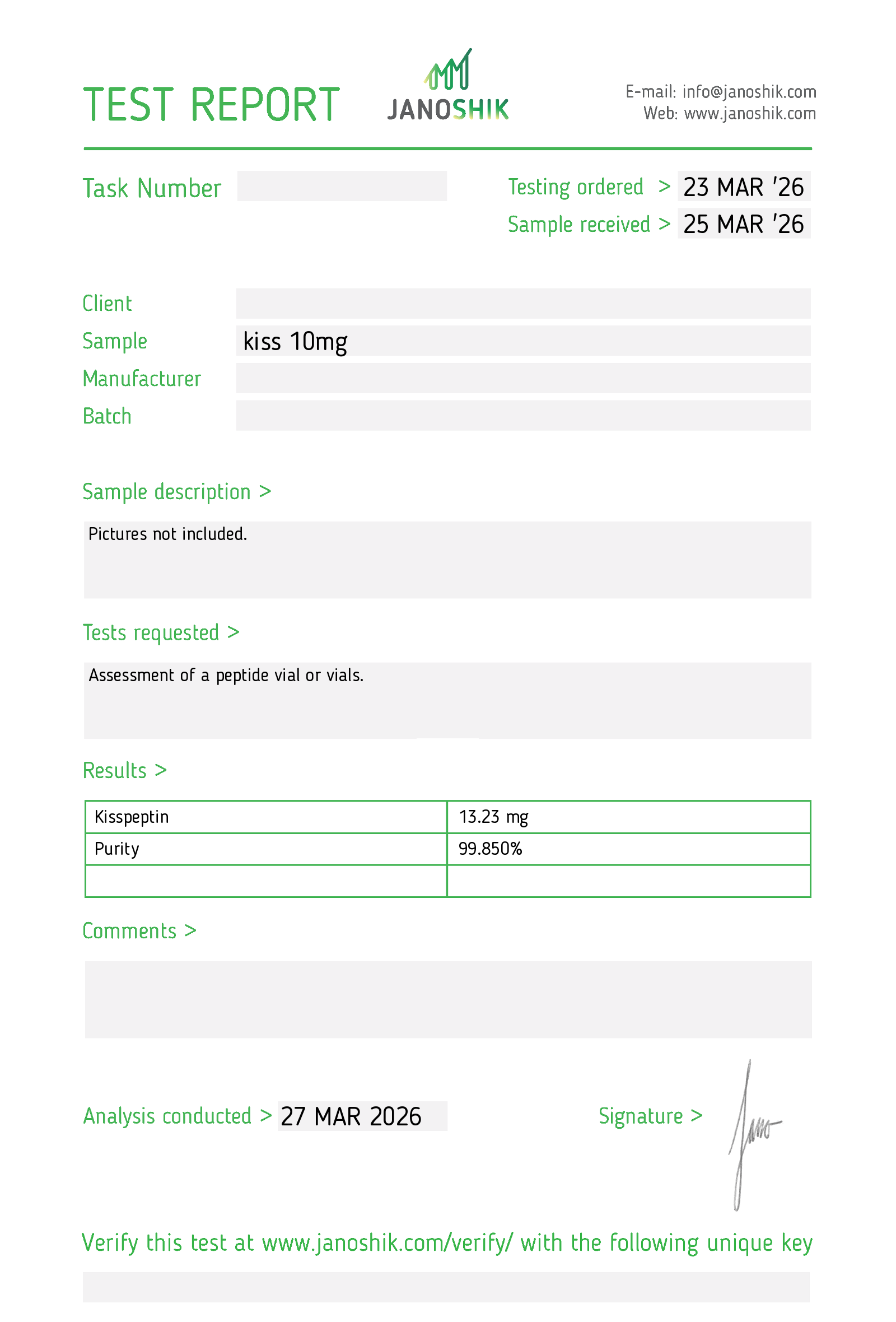
| Purity | 99.85% by RP-HPLC, Janoshik Analytical |
| Analysed | 27 March 2026 |
Research profile: Kisspeptin: structure, mechanism and research use
Independent test: a sample of this product was analysed by Janoshik Analytical on 27 March 2026, purity 99.85% by RP-HPLC. The certificate is shown in the lab band on this page.