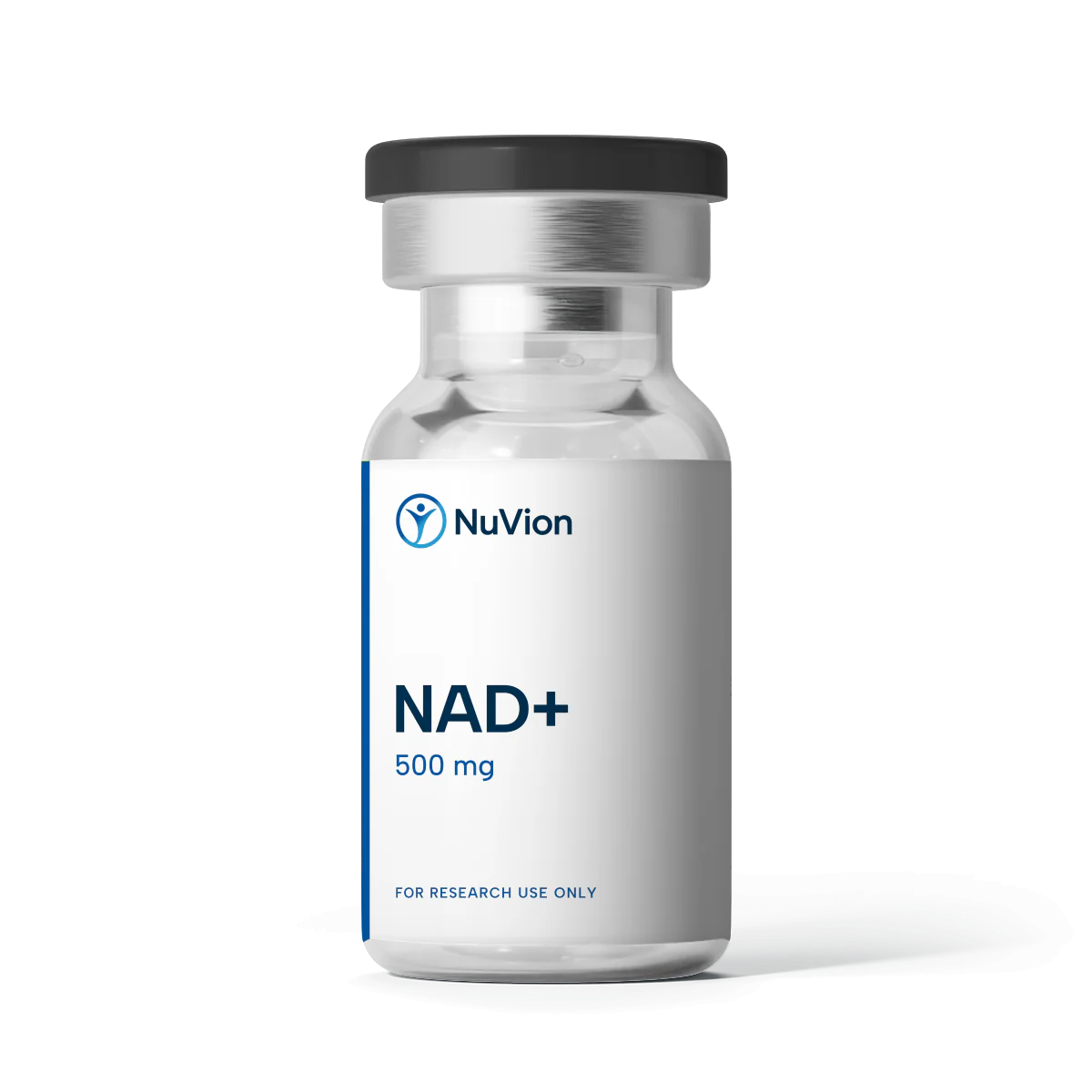
Nicotinamide adenine dinucleotide (NAD+) is a dinucleotide coenzyme that shuttles hydride between substrates and oxidoreductase enzymes, and that is also consumed as a substrate by enzymes which cleave the bond joining nicotinamide to ribose. It sits at the centre of glycolysis, the citric acid cycle and oxidative phosphorylation, and of sirtuin, PARP and CD38 biochemistry, so it turns up in enzyme kinetics work, metabolic flux measurement and ADP-ribosylation chemistry. NAD+ is supplied by NuVion Health as a laboratory chemical for in vitro research use only.
Key facts
| Type / class | Dinucleotide coenzyme, a small molecule and not a peptide |
| Molecular formula | C21H27N7O14P2 (free acid) |
| Molecular weight | 663.4 g/mol |
| CAS number | 53-84-9 |
| Synonyms | Nadide, coenzyme I, beta-NAD, diphosphopyridine nucleotide (DPN) |
| Supplied form | Lyophilised powder in a sealed vial |

Structure and chemistry
NAD+ is built from two ribonucleotides joined 5′ to 5′ through a pyrophosphate bridge: adenosine 5′-monophosphate on one side and nicotinamide mononucleotide on the other. The nicotinamide ring is attached to its ribose through a beta-N-glycosidic bond at the ring nitrogen, which leaves that nitrogen quaternary and positively charged. The plus sign in NAD+ denotes that pyridinium charge in the oxidised form; the molecule as a whole carries net negative charge from its two phosphate groups. Phosphorylation of the 2′-hydroxyl on the adenosine ribose gives NADP+, a separate coenzyme pool used largely by reductive biosynthetic and antioxidant enzymes.
Redox chemistry happens at carbon 4 of the pyridinium ring. The ring accepts a hydride, two electrons with one proton, to give 1,4-dihydronicotinamide, the reduced form written as NADH. That change alters the ultraviolet spectrum in a way that underpins most of the assay chemistry built around the coenzyme: both forms absorb near 260 nm through the adenine ring, while only the reduced form absorbs at 340 nm. Stability differs between the two forms. The oxidised form is comparatively stable at acidic pH and degrades at alkaline pH, while the reduced form behaves the opposite way, and both are subject to slow hydrolysis of the glycosidic bond in aqueous solution. Solutions are therefore made up close to the time of use and aliquoted to limit repeated freezing and thawing.
Mechanism of action
In its coenzyme role NAD+ is a two-electron carrier for several hundred dehydrogenases, most of which bind it through a Rossmann fold. Glyceraldehyde-3-phosphate dehydrogenase reduces it during glycolysis, lactate dehydrogenase reoxidises it in the cytosol, and isocitrate dehydrogenase, the alpha-ketoglutarate dehydrogenase complex and malate dehydrogenase reduce it in the citric acid cycle. NADH then donates electrons to complex I of the mitochondrial electron transport chain. Because the inner mitochondrial membrane is impermeable to the coenzyme, cytosolic and mitochondrial pools are kinetically separate and reducing equivalents move between them through the malate-aspartate and glycerol-3-phosphate shuttles. The ratio of oxidised to reduced coenzyme sets the thermodynamic pull on every one of these reactions and is measured in cell lysates as a readout of redox state.
A second set of enzymes uses NAD+ stoichiometrically as a substrate, cleaving the nicotinamide-ribose bond and releasing nicotinamide. Sirtuins (SIRT1 to SIRT7) are class III protein deacylases that couple removal of an acetyl or acyl group from a lysine residue to production of nicotinamide and 2′-O-acetyl-ADP-ribose, and nicotinamide feeds back as a product inhibitor. Poly(ADP-ribose) polymerases, chiefly PARP1 and PARP2, bind DNA strand breaks and build poly(ADP-ribose) chains on acceptor proteins from the same substrate, which links coenzyme turnover to DNA repair signalling. The glycohydrolases CD38 and CD157 convert it into cyclic ADP-ribose and ADP-ribose, and generate NAADP by base exchange, giving second messengers that act on calcium release channels. The TIR domain of SARM1 is a further NAD+ glycohydrolase, and structural work has shown NAD+ binding at an allosteric armadillo-repeat site that keeps that activity in check.
Consumption by those enzymes means the pool has to be resupplied. The salvage route dominates in most cell types: nicotinamide phosphoribosyltransferase (NAMPT) converts nicotinamide to nicotinamide mononucleotide, and the nicotinamide mononucleotide adenylyltransferases NMNAT1, NMNAT2 and NMNAT3, resident in the nucleus, cytosol and mitochondria respectively, add the adenylyl group. The Preiss-Handler route starts from nicotinic acid through NAPRT, and de novo synthesis proceeds from tryptophan through the kynurenine pathway to quinolinate. Non-canonical chemistry is also described, including NAD capping of RNA transcripts.
Research applications
- Coupled spectrophotometric enzyme assays that follow absorbance at 340 nm to measure dehydrogenase kinetics, Km and inhibitor constants.
- Sirtuin deacylase activity assays, including fluorogenic peptide substrate formats and nicotinamide product inhibition studies.
- PARP and mono-ADP-ribosyltransferase activity assays, and characterisation of ADP-ribosylated proteins in cell lysates.
- Quantification of the coenzyme pool by ion-pairing HPLC or LC-MS/MS, and enzymatic redox cycling assays for the oxidised to reduced ratio.
- Mitochondrial respiration measurements in permeabilised cells and isolated organelles, where substrate and coenzyme concentrations are titrated directly.
- Reference standard work for HPLC method development, including retention time and calibration curve construction.
On the NuVion catalogue the compound sits in the Cellular Ageing category, alongside mitochondrial and coenzyme-adjacent research compounds.
Handling in the laboratory
The lyophilised solid is reconstituted with bacteriostatic water, and the reconstitution calculator works out the concentration reached for a given volume of solvent. Add solvent gently down the vial wall and allow the solid to dissolve without vigorous agitation. Keep unopened lyophilised material sealed, dry and away from light, refrigerated as set out in the product documentation. Once in solution, keep the vial refrigerated and use it within the period stated in that documentation. Buffers well above neutral pH accelerate loss of the oxidised form, so near-neutral or slightly acidic buffers are the usual choice for stock solutions. Material is characterised by RP-HPLC for purity and by mass spectrometry for identity.
Testing and supply from NuVion
NuVion Health has material independently tested by Janoshik Analytical, with purity determined by RP-HPLC and identity by mass spectrometry. Most batches are tested and the Certificate of Analysis for a tested batch is published on the product page, with the wider set collected in the certificate of analysis library. Manufacture is GMP-audited. Vials are supplied lyophilised and sealed, and orders are dispatched from within Australia.
Related compounds
Groups working on coenzyme turnover and mitochondrial biochemistry often run this compound next to MOTS-c, a mitochondrial-derived peptide studied in AMPK signalling, and SS-31, a cardiolipin-binding tetrapeptide used in inner-membrane work. The principal thiol couple that NADPH keeps reduced is covered in glutathione.
Frequently asked questions
What is NAD+ used for in research?
It is used as a coenzyme in dehydrogenase assays, as the substrate in sirtuin and PARP activity assays, and as an analytical reference standard. Laboratories studying redox state also use it to construct calibration curves for measuring the oxidised and reduced pools in cell extracts.
Is NAD+ a peptide?
No. It is a dinucleotide made of two ribonucleotides linked by a pyrophosphate bridge, so it has no amino acids and no peptide bonds. It is grouped with the peptide catalogue for convenience because it is handled in the same lyophilised format and reconstituted the same way.
Is NAD+ a therapeutic good in Australia?
No. The material supplied here is a laboratory chemical. It is not entered in the Australian Register of Therapeutic Goods and the Therapeutic Goods Administration has not assessed it. It is sold for in vitro laboratory research and for no other purpose.
How should NAD+ be stored?
Keep the sealed vial of lyophilised solid dry, away from light and refrigerated as described in the product documentation. After reconstitution, keep the solution refrigerated and use it within the period the documentation gives. Aliquoting the stock limits repeated freeze-thaw of the same material.
Research use only. This product is a laboratory chemical supplied for in vitro research. It is not included in the Australian Register of Therapeutic Goods and has not been assessed by the Therapeutic Goods Administration for quality, safety or efficacy. It is not for human or veterinary use, and nothing on this page is a representation about therapeutic use.