
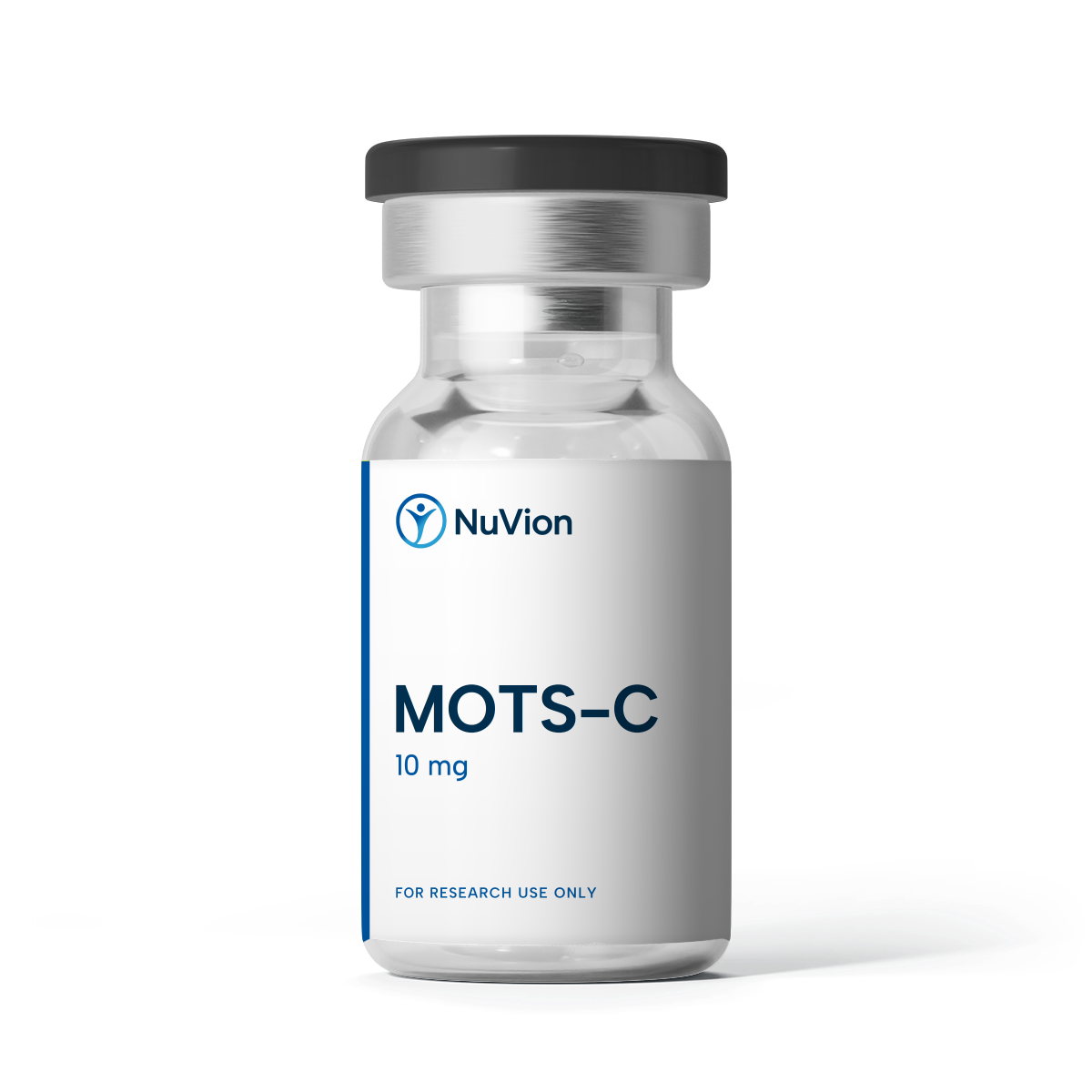
MOTS-C and SS-31 are both described as mitochondrial peptides, for opposite reasons. MOTS-C comes from the mitochondrion: it is a 16-residue peptide encoded in mitochondrial DNA. SS-31 goes to the mitochondrion: it is a synthetic tetrapeptide designed to concentrate at the inner mitochondrial membrane. This page compares their origin, target and laboratory use.
At a glance
| MOTS-C | SS-31 | |
|---|---|---|
| Type | Mitochondrial-derived peptide, made synthetically | Synthetic mitochondria-targeted peptide |
| Length | 16 amino acids | 4 amino acids |
| Sequence | Met-Arg-Trp-Gln-Glu-Met-Gly-Tyr-Ile-Phe-Tyr-Pro-Arg-Lys-Leu-Arg | D-Arg-Dmt-Lys-Phe-NH2 |
| Origin | Open reading frame in the mitochondrial 12S rRNA gene | Designed, from the Szeto-Schiller series |
| Studied at | AMPK signalling | Cardiolipin in the inner mitochondrial membrane |
| Also known as | MT-RNR1-derived peptide | Elamipretide, MTP-131 |
| NuVion vial sizes | 10mg and 20mg | 10mg |
Structure
MOTS-C is a linear peptide of 16 natural amino acids. It is unusual because its gene sits inside the mitochondrial genome, within the sequence that codes for 12S ribosomal RNA, where almost all other peptides are encoded in the nucleus.
SS-31 is a tetrapeptide with alternating aromatic and basic residues. Two of its four residues are not standard: D-arginine and 2′,6′-dimethyltyrosine, written Dmt. The alternating pattern and the positive charge are what carry it across membranes and into mitochondria.
Mechanism at the cell level
MOTS-C is studied as a signalling peptide. In myotube, hepatocyte and adipocyte cultures it is used in work on AMPK phosphorylation and glucose uptake. SS-31 is studied as a membrane-binding peptide. It associates with cardiolipin, a phospholipid found almost only in the inner mitochondrial membrane, and is used in work on electron transport chain function and mitochondrial membrane potential.
Where each is used in research
- MOTS-C: AMPK phosphorylation assays in myotube and hepatocyte cultures
- MOTS-C: glucose uptake assays in adipocyte cultures
- SS-31: cardiolipin binding studies
- SS-31: mitochondrial membrane potential and respiration assays
Supplied by NuVion
NuVion stocks both in Australia as lyophilised vials: MOTS-C in 10mg and 20mg and SS-31 in 10mg. Both are part of the Cellular Ageing Set (Extended), and MOTS-C is also sold with 5-Amino-1MQ as the NNMT and Mitochondrial Pair. Published certificates are shown on each product page and in the COA library.
Frequently asked questions
What is the difference between MOTS-C and SS-31?
MOTS-C is a 16-residue peptide encoded in mitochondrial DNA and studied at AMPK signalling. SS-31 is a designed 4-residue peptide that binds cardiolipin in the inner mitochondrial membrane.
Is SS-31 the same as elamipretide?
Yes. Elamipretide and MTP-131 are other names for the same tetrapeptide, D-Arg-Dmt-Lys-Phe-NH2.
Are MOTS-C and SS-31 therapeutic goods in Australia?
No. NuVion’s MOTS-C and SS-31 are laboratory chemicals for in vitro research. They are not included in the Australian Register of Therapeutic Goods, have not been assessed by the Therapeutic Goods Administration, and are not for human or veterinary use.
Research use only. These products are laboratory chemicals supplied for in vitro research. They are not included in the Australian Register of Therapeutic Goods and have not been assessed by the Therapeutic Goods Administration for quality, safety or efficacy. They are not for human or veterinary use, and nothing on this page is a representation about therapeutic use.