
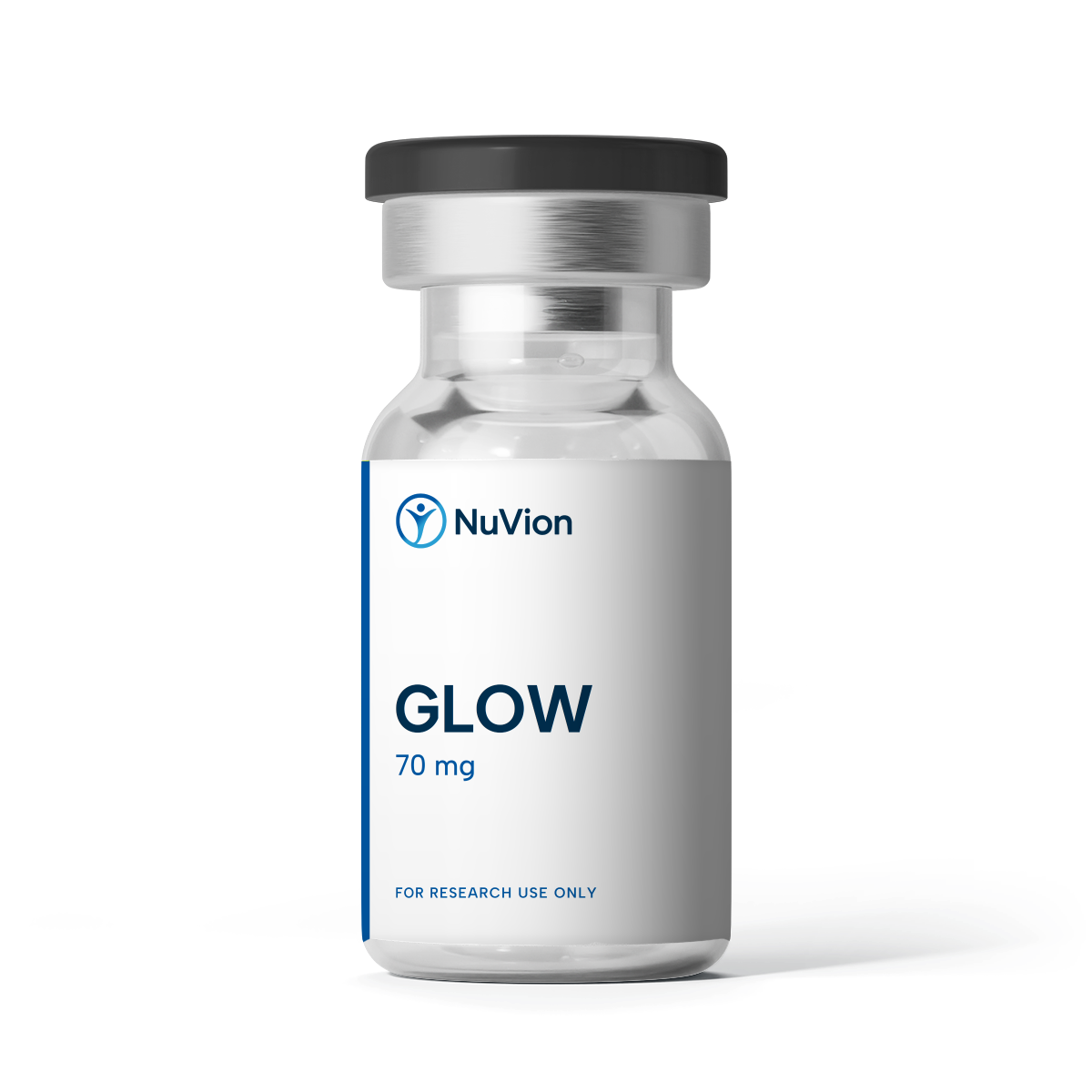
GLOW and KLOW are peptide blends supplied in a single vial, and the difference between them is one component. GLOW combines GHK-Cu, BPC-157 and TB-500. KLOW contains the same three and adds KPV. This page sets out what is in each blend and how the components differ.
At a glance
| GLOW | KLOW | |
|---|---|---|
| Components | Three | Four |
| GHK-Cu | Yes | Yes |
| BPC-157 | Yes | Yes |
| TB-500 | Yes | Yes |
| KPV | No | Yes |
| Vial content | 70 mg total peptide | 80 mg total peptide |
| Supplied form | Lyophilised, one vial | Lyophilised, one vial |
The components
Each component is a distinct molecule with its own profile. GHK-Cu is the tripeptide Gly-His-Lys bound to copper(II). BPC-157 is a 15-residue synthetic peptide modelled on a sequence from a gastric protein. TB-500 is a fragment of thymosin beta-4 that carries its actin-binding motif. KPV, found only in KLOW, is the tripeptide Lys-Pro-Val, residues 11 to 13 of alpha-melanocyte-stimulating hormone.
The three shared components are studied in overlapping cell models: GHK-Cu in matrix synthesis and fibroblast work, BPC-157 in cell migration and adhesion assays, and TB-500 in actin dynamics. KPV is studied in a different area, cytokine transcription in cell-based models, which is the reason for choosing one blend over the other.
Blend or separate vials
A blend fixes the ratio of its components, which suits work where all of them are applied together every time. Where an experiment needs the components at different concentrations, or needs one left out as a control, separate vials are the better fit. NuVion stocks every component on its own and sells the same compounds as sets with each in its own vial.
Where each is used in research
- GLOW: fibroblast, endothelial and keratinocyte cultures where matrix synthesis and cell migration are examined together
- KLOW: the same models with cytokine expression added as an endpoint
- Single components: controls and concentration series alongside either blend
Supplied by NuVion
NuVion stocks GLOW as a 70mg vial and KLOW as an 80mg vial, both in Australia. The components are available singly as GHK-Cu, BPC-157, TB-500 and KPV, and in separate vials as the Tissue Repair Set (Extended). Published certificates are shown on each product page and in the COA library. The two most closely related components are compared in BPC-157 vs TB-500.
Frequently asked questions
What is the difference between GLOW and KLOW?
KPV. GLOW is GHK-Cu, BPC-157 and TB-500 in a 70mg vial. KLOW is those three plus KPV in an 80mg vial.
Can the components be bought separately?
Yes. NuVion stocks GHK-Cu, BPC-157, TB-500 and KPV as single vials, and all four together in separate vials as the Tissue Repair Set (Extended).
Are GLOW and KLOW therapeutic goods in Australia?
No. NuVion’s GLOW and KLOW are laboratory chemicals for in vitro research. They are not included in the Australian Register of Therapeutic Goods, have not been assessed by the Therapeutic Goods Administration, and are not for human or veterinary use.
Research use only. These products are laboratory chemicals supplied for in vitro research. They are not included in the Australian Register of Therapeutic Goods and have not been assessed by the Therapeutic Goods Administration for quality, safety or efficacy. They are not for human or veterinary use, and nothing on this page is a representation about therapeutic use.