
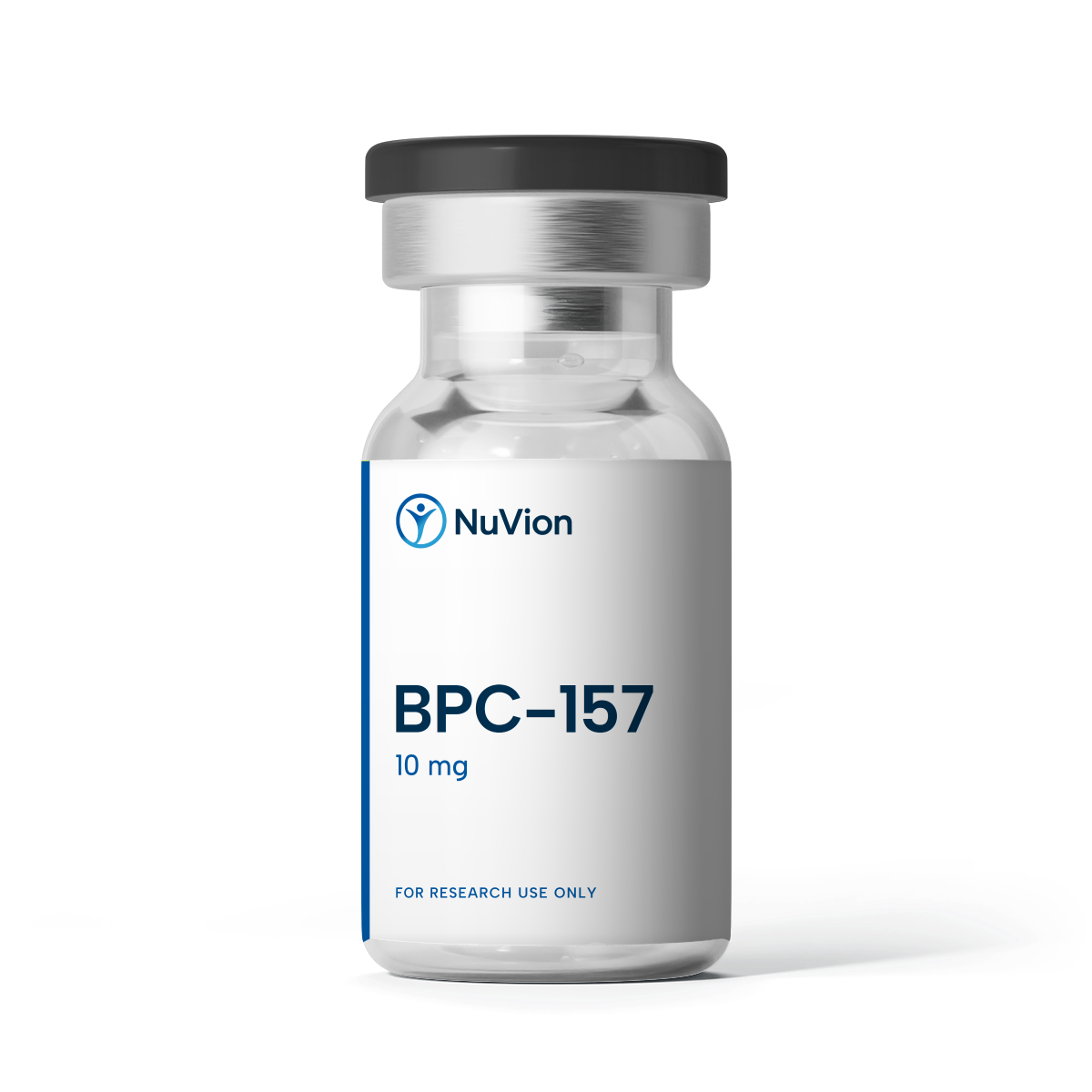
BPC-157 and TB-500 are often run side by side in cell migration research, and they are unrelated molecules. BPC-157 is a 15-residue synthetic peptide modelled on a sequence from a gastric protein. TB-500 is a 7-residue fragment of thymosin beta-4 that carries its actin-binding motif. This page sets out how the two differ in structure, molecular target and laboratory use.
At a glance
| BPC-157 | TB-500 | |
|---|---|---|
| Type | Synthetic pentadecapeptide | Synthetic peptide fragment, N-terminally acetylated |
| Length | 15 amino acids | 7 amino acids |
| Sequence | Gly-Glu-Pro-Pro-Pro-Gly-Lys-Pro-Ala-Asp-Asp-Ala-Gly-Leu-Val | Ac-Leu-Lys-Lys-Thr-Glu-Thr-Gln |
| Derived from | A partial sequence of a protein found in gastric juice | Residues 17 to 23 of thymosin beta-4 |
| Studied at | Focal adhesion and VEGFR2 signalling | Monomeric actin |
| NuVion vial sizes | 10mg and 20mg | 10mg |
Structure
BPC-157 is proline rich, with a run of three prolines near the N-terminus, and it has no disulfide bonds or unusual residues. That composition keeps it chemically stable in aqueous solution compared with most peptides of its size.
TB-500 is much smaller. It is the acetylated heptapeptide Ac-LKKTETQ, the stretch of the 43-residue protein thymosin beta-4 that binds actin. The full protein and the fragment are different molecules, and the thymosin beta-4 profile covers the parent.
Mechanism at the cell level
In cell models BPC-157 is studied for its effect on focal adhesion signalling, including phosphorylation of focal adhesion kinase and paxillin, and on VEGFR2 signalling in endothelial cells. TB-500 is studied through a separate route. Its LKKTET motif binds monomeric actin, so it is used to probe actin polymerisation and the cytoskeletal changes that accompany cell movement.
Where each is used in research
- BPC-157: fibroblast and endothelial cell migration assays
- BPC-157: focal adhesion kinase and paxillin phosphorylation readouts
- TB-500: actin binding and polymerisation assays
- TB-500: endothelial and epithelial cell migration assays
Supplied by NuVion
NuVion stocks both in Australia as lyophilised vials: BPC-157 in 10mg and 20mg and TB-500 in 10mg. The two are sold together in separate vials as the Tissue Repair Pair, and blended in one vial with GHK-Cu as GLOW or with GHK-Cu and KPV as KLOW. Published certificates are shown on each product page and in the COA library, and the peptide calculator works out the strength of a mixed vial in mg per ml.
Frequently asked questions
Are BPC-157 and TB-500 the same thing?
No. They share no sequence and come from different parent proteins. BPC-157 has 15 residues and is studied at focal adhesion signalling. TB-500 has 7 and binds actin.
Is TB-500 the same as thymosin beta-4?
No. Thymosin beta-4 is the full 43-residue protein. TB-500 as supplied by NuVion is the 7-residue fragment Ac-LKKTETQ taken from it.
Are BPC-157 and TB-500 therapeutic goods in Australia?
No. NuVion’s BPC-157 and TB-500 are laboratory chemicals for in vitro research. They are not included in the Australian Register of Therapeutic Goods, have not been assessed by the Therapeutic Goods Administration, and are not for human or veterinary use.
Research use only. These products are laboratory chemicals supplied for in vitro research. They are not included in the Australian Register of Therapeutic Goods and have not been assessed by the Therapeutic Goods Administration for quality, safety or efficacy. They are not for human or veterinary use, and nothing on this page is a representation about therapeutic use.