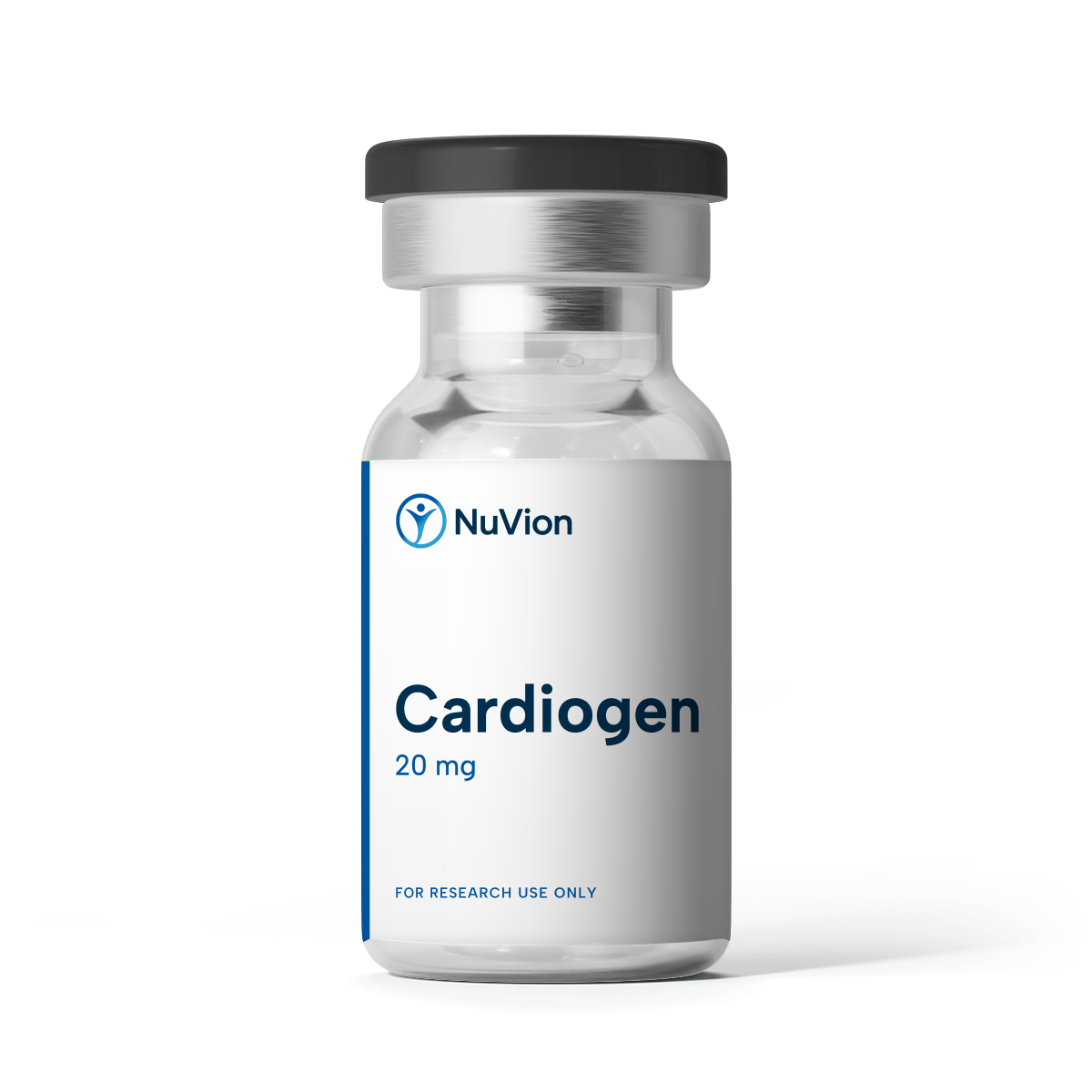

Cardiogen is a synthetic tetrapeptide bioregulator (Ala-Glu-Asp-Arg) developed within the Khavinson research programme. It is studied for binding at DNA promoter regions and for its effect on cytoskeletal and nuclear matrix protein expression in cardiac cell models, and NuVion stocks it in Australia as a 20mg lyophilised vial.
- Synthetic tetrapeptide bioregulator (Ala-Glu-Asp-Arg)
- Studied for binding at DNA promoter regions in cell models
- Used in cardiomyocyte culture models
- Supplied lyophilised, purity by RP-HPLC and identity by mass spectrometry
Cardiogen structure and research use
Cardiogen is four amino acids long, Ala-Glu-Asp-Arg, which is where the short name AEDR comes from. It belongs to the Khavinson series of short peptide bioregulators and shares its first three residues with Epithalon (AEDG) and Bronchogen (AEDL), differing only at the fourth. In the laboratory it is used in cardiomyocyte culture for work on DNA promoter binding and the expression of cytoskeletal and nuclear matrix proteins.
Cardiogen (AEDR) research applications
- Circular dichroism and duplex melting compare binding to methylated and unmethylated CNG motifs in synthetic DNA
- qPCR, immunofluorescence and Western blot profile cytoskeletal and nuclear matrix proteins in cardiomyocyte and cardiac fibroblast cultures
- Paired assays with the tripeptide Pinealon test how the N-terminal alanine affects DNA binding and stability
- LC-MS and RP-HPLC method development uses the tetrapeptide as a reference standard for short basic-acidic peptides
Cardiogen (AEDR) key facts
| Type | Synthetic tetrapeptide bioregulator |
|---|---|
| Amino acid count | 4 |
| Sequence | H-Ala-Glu-Asp-Arg-OH (AEDR) |
| Molecular formula | C19H33N7O8 |
| Molecular weight | 489.5 g/mol |
| Series | Khavinson short peptide bioregulators |
| Also known as | AEDR, Ala-Glu-Asp-Arg, cardiogen tetrapeptide |
| Vial size | 20mg, lyophilised |
| Purity | 99.44% by RP-HPLC, Janoshik Analytical |
| Analysed | 28 January 2026 |
Research profile: Cardiogen: structure, mechanism and research use
Independent test: a sample of this product was analysed by Janoshik Analytical on 28 January 2026, purity 99.44% by RP-HPLC. The certificate is shown in the lab band on this page.