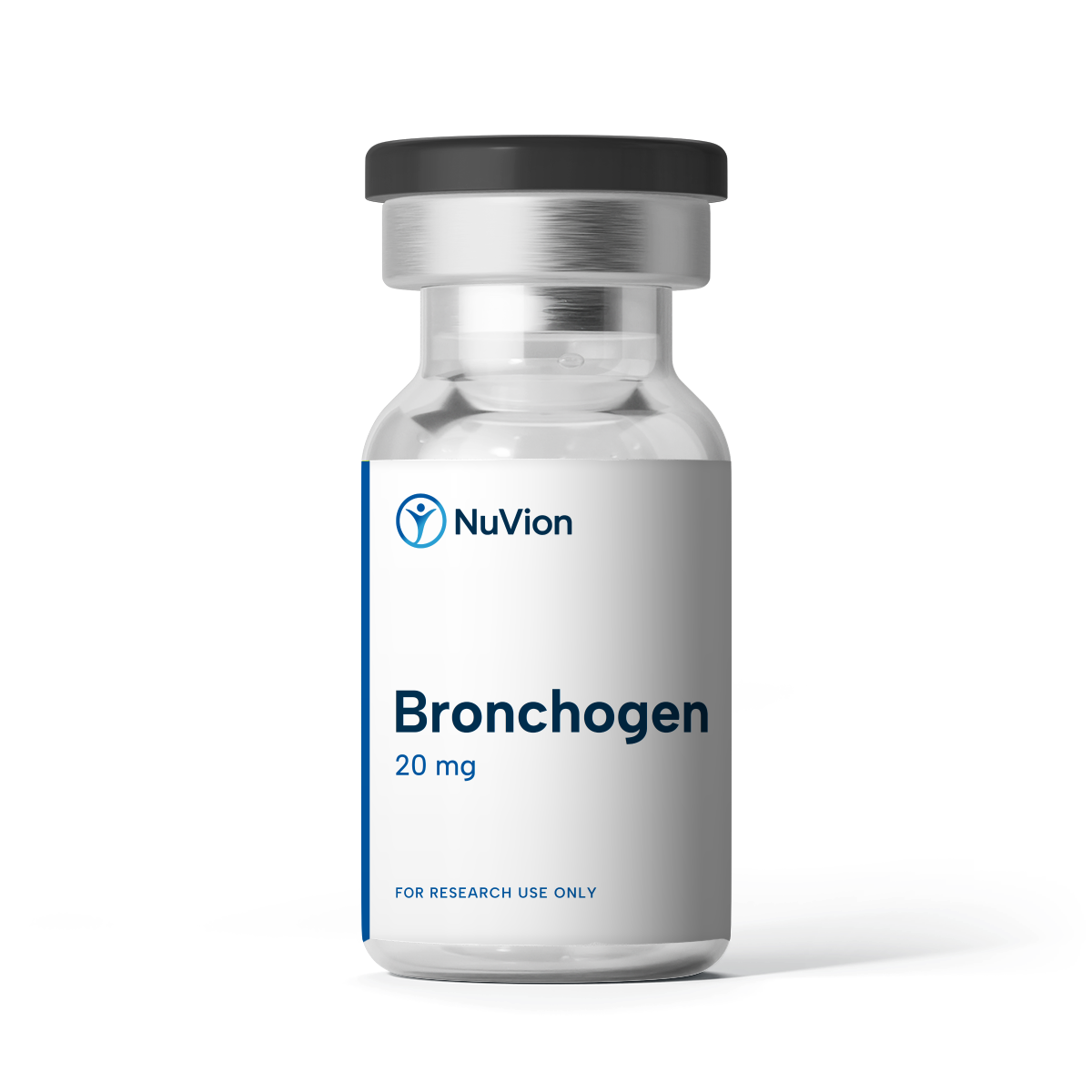

Bronchogen (AEDL)

A$109.00

Bronchogen (AEDL), an Ala-Glu-Asp-Leu tetrapeptide bioregulator studied in respiratory models.

Research use only. Not for human or veterinary use.

In stock

All prices are in AUD. Ships from Australia with tracked express shipping, $15 flat, 1 to 2 business days, free on orders over $200. Research use only, not for human or veterinary use.

  • Testing status on this page
  • Same-day dispatch before 2pm
  • Dispatched from Australia
  • Card, Apple Pay & Google Pay

Research use only

Not for human or veterinary use.

Laboratory chemical

Supplied for in vitro research. We publish specifications and handling guidance only, with no protocols and no advice on use.

Not on the ARTG

Absent from the Australian Register of Therapeutic Goods and never evaluated by the TGA for safety, quality or efficacy. Absence from the register is not an approval and does not authorise any other use.

Who can order

You must be 18 or over and purchasing solely for lawful research.

What is Bronchogen (AEDL)?

Bronchogen is a synthetic tetrapeptide bioregulator (Ala-Glu-Asp-Leu) from the Khavinson short peptide series. It is studied for interaction with DNA at CNG methylation sites and for its effect on lung-specific gene expression in cell models, and NuVion stocks it in Australia as a 20mg lyophilised vial.

  • Synthetic tetrapeptide bioregulator (Ala-Glu-Asp-Leu)
  • Studied for DNA interaction at CNG methylation sites
  • Used in bronchial epithelial cell culture research
  • Supplied lyophilised, purity by RP-HPLC and identity by mass spectrometry

Bronchogen structure and research use

Bronchogen is four amino acids long, Ala-Glu-Asp-Leu, which is where the short name AEDL comes from. It belongs to the Khavinson series of short peptide bioregulators and shares its first three residues with Epithalon (AEDG) and Cardiogen (AEDR), differing only at the fourth. In the laboratory it is used in bronchial epithelial cell culture for work on DNA binding and gene expression.

Bronchogen (AEDL) research applications

  • Circular dichroism, thermal denaturation and gel-shift assays test binding to short synthetic DNA duplexes containing CNG motifs
  • qPCR or RNA-seq profiles lineage and differentiation marker transcripts in bronchial epithelial and fibroblast cultures
  • Immunocytochemistry and Western blot quantify differentiation marker proteins in primary and immortalised airway cell lines
  • LC-MS peptidase stability assays follow loss of the parent tetrapeptide in serum and cell lysate

Bronchogen (AEDL) key facts

Type Synthetic tetrapeptide bioregulator
Amino acid count 4
Sequence H-Ala-Glu-Asp-Leu-OH (AEDL)
Molecular formula C19H32N4O8
Molecular weight 446.5 g/mol
Series Khavinson short peptide bioregulators
Also known as AEDL, Ala-Glu-Asp-Leu, bronchogen tetrapeptide
Vial size 20mg, lyophilised
Purity 99.77% by RP-HPLC, Janoshik Analytical
Analysed 9 April 2026

Independent test: a sample of this product was analysed by Janoshik Analytical on 9 April 2026, purity 99.77% by RP-HPLC. The certificate is shown in the lab band on this page.
Why buy Bronchogen (AEDL) from NuVion

Testing status on every page

Published results show the measured purity, the date and the certificate.

Australian stock, domestic post

Held in Australia and sent tracked in plain outer packaging.

Specifications

Storing and handling Bronchogen (AEDL)

Before reconstitution
Keep the sealed vial cool, dry and out of direct light. General practice for lyophilised peptides.
After reconstitution
Reconstitute with bacteriostatic or sterile water, store at 2 to 8°C and avoid repeated freeze-thaw cycles. No stability-tested shelf life is published for this product.

Reconstitution and storage Volumes, concentrations and storage at a glance.

Bronchogen (AEDL) questions

Where can I buy Bronchogen in Australia?
NuVion stocks Bronchogen in Australia as a 20mg vial of lyophilised powder, posted from Australian stock on a tracked express service. A sample was analysed by Janoshik Analytical on 9 April 2026, with purity of 99.77% by RP-HPLC. Bacteriostatic water is sold separately. Bronchogen is supplied as a research material only and is not on the Australian Register of Therapeutic Goods.
What is Bronchogen used for in research?
It is used as a defined tetrapeptide stimulus in cell-based studies of gene expression in airway epithelial and fibroblast cultures, in DNA-binding experiments with short synthetic duplexes, and as one member of a structure-activity series across the Khavinson short peptides.
How does Bronchogen (AEDL) work at the cell level?
No receptor has been identified for Bronchogen, and the mechanism is described at the level of the molecular interactions and cellular readouts that have been measured. The model proposed by the group that developed the series is that short acidic peptides of this kind enter the nucleus and bind double-stranded DNA at CNG sites, where the methylation state of the central cytosine alters the local geometry of the groove. The Bronchogen (AEDL) research profile covers the mechanism in full.
What does the leucine residue change in Bronchogen?
Leucine at position four gives Bronchogen its only hydrophobic residue. The other three residues match the wholly polar Epithalon sequence, so the substitution makes the tetrapeptide amphipathic while it keeps a net negative charge of two at neutral pH.
Why is Bronchogen short-lived in serum-containing culture medium?
Aminopeptidases in serum cleave Bronchogen from its free N-terminal alanine, so the parent tetrapeptide is lost quickly in complete medium. Peptidase stability assays follow that loss by LC-MS in serum and cell lysate.
How is Bronchogen identified by mass spectrometry?
Bronchogen has a molecular weight of 446.5 g/mol and the formula C19H32N4O8, and mass spectrometry shows its parent ion at m/z 447. The tetrapeptide has no spectroscopic handle for concentration checks, so LC-MS is also used to measure loss in solution.
What does AEDL stand for?
The one-letter codes of its four amino acids: alanine (A), glutamic acid (E), aspartic acid (D) and leucine (L).
What is the difference between Bronchogen and Cardiogen?
One amino acid. Bronchogen ends in leucine (AEDL) and Cardiogen ends in arginine (AEDR). Both come from the same Khavinson series as Epithalon (AEDG).

Shipping, returns and wholesale orders are covered in the FAQs.

Related research peptides

NuVion Sermorelin research peptide vial
5mg

Original price was: A$79.00.Current price is: A$69.00.

NuVion Ipamorelin research peptide vial
10mg

A$79.00

NuVion 5-Amino-1MQ research vial
10mg

Original price was: A$69.00.Current price is: A$59.00.

NuVion Oxytocin research peptide vial
10mg

A$59.00