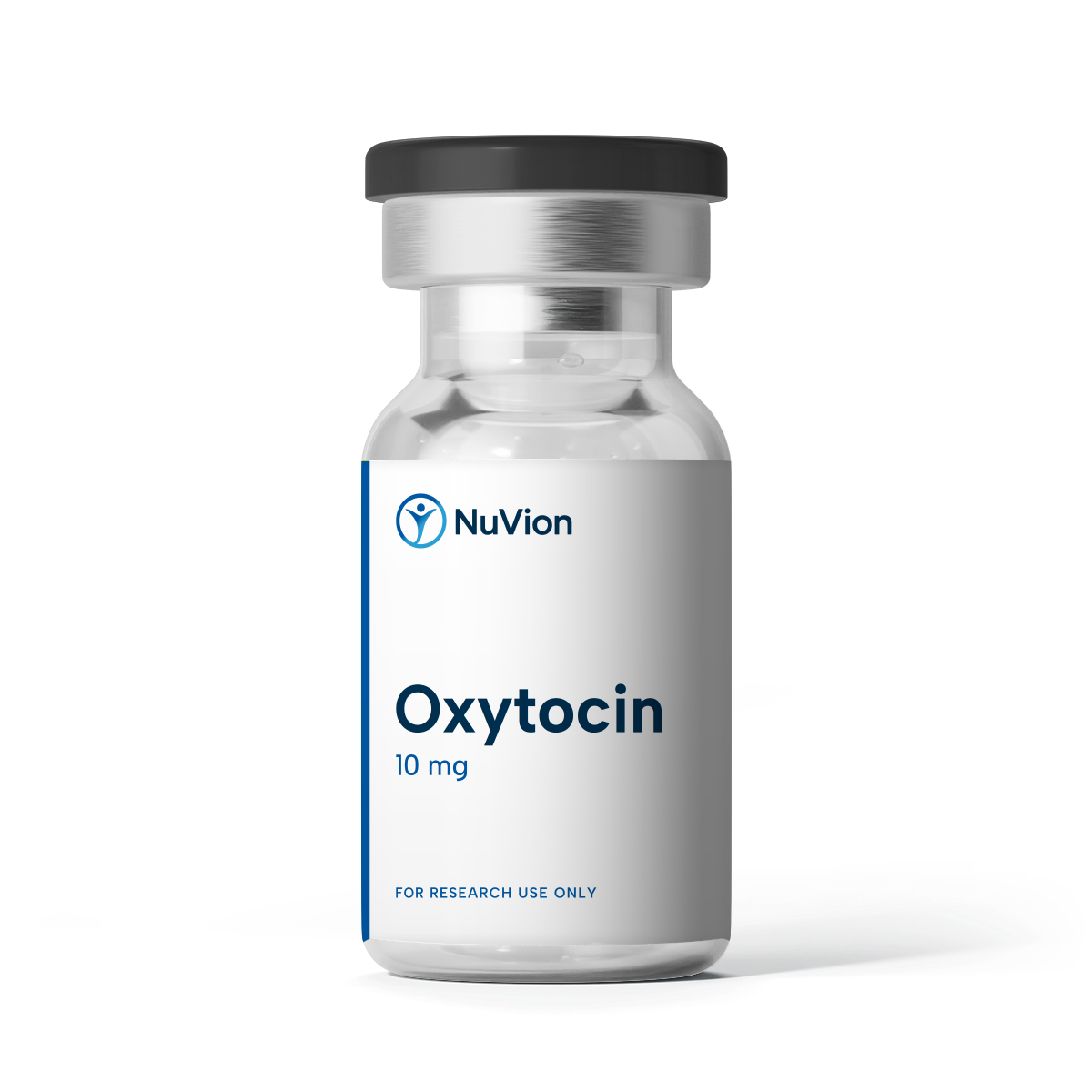


Oxytocin is a nine amino acid neuropeptide and the reference ligand at the OXTR receptor. It is used in neuronal and smooth muscle culture to study receptor binding and neuroendocrine signalling, and NuVion stocks it in Australia as a 10mg lyophilised vial.
- Nine amino acid neuropeptide, reference ligand at the OXTR receptor
- Used in neuronal and smooth muscle culture models
- Applied in receptor binding and second messenger assays
- Supplied lyophilised, purity by RP-HPLC and identity by mass spectrometry
Oxytocin structure and research use
Oxytocin has the sequence Cys-Tyr-Ile-Gln-Asn-Cys-Pro-Leu-Gly-NH2, with a disulfide bridge between the two cysteines that closes six of the residues into a ring. It binds the oxytocin receptor, a G protein-coupled receptor that signals through Gq and intracellular calcium. In the laboratory it is used as the reference agonist in receptor binding and second messenger assays.
Oxytocin research applications
- Calcium mobilisation measured with Fluo-4 or Fura-2 in HEK293 or CHO cells expressing OXTR
- Competitive radioligand binding at OXTR and the V1a, V1b and V2 receptors to derive selectivity ratios
- Collagen gel contraction and myosin light chain phosphorylation in myometrial smooth muscle cell lines
- Cholesterol and magnesium dependence of agonist binding, measured in reconstituted membranes
Oxytocin key facts
| Type | Synthetic cyclic peptide, neurohypophysial hormone, OXTR agonist |
|---|---|
| Amino acid count | 9 |
| Sequence | Cys-Tyr-Ile-Gln-Asn-Cys-Pro-Leu-Gly-NH2, disulfide Cys1-Cys6 (CYIQNCPLG-NH2) |
| Also known as | OT, OXT, ocytocin, oxytocin acetate (salt form) |
| Vial size | 10mg, lyophilised |
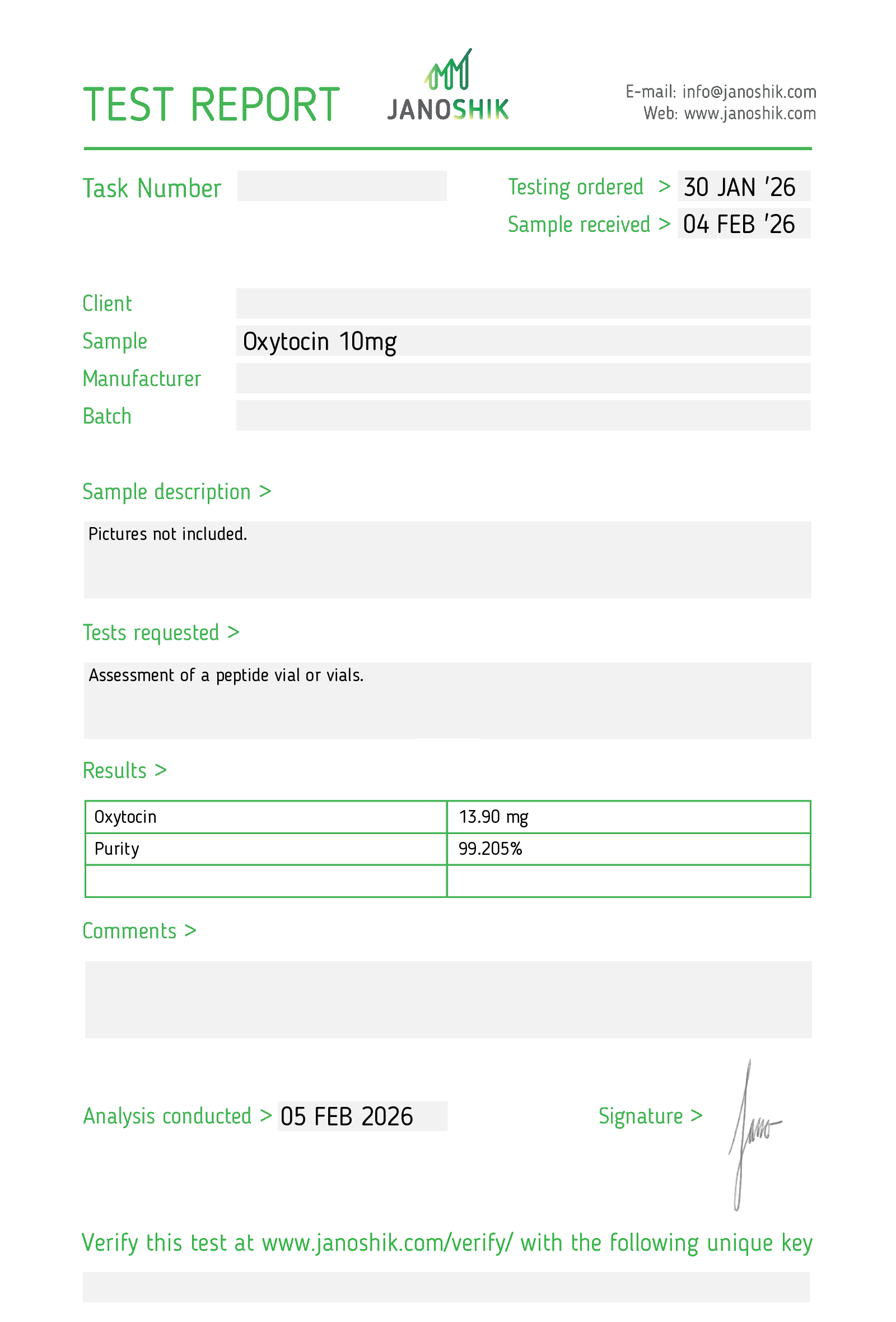
| Purity | 99.21% by RP-HPLC, Janoshik Analytical |
| Analysed | 5 February 2026 |
Research profile: Oxytocin: structure, mechanism and research use
Independent test: a sample of this product was analysed by Janoshik Analytical on 5 February 2026, purity 99.21% by RP-HPLC. The certificate is shown in the lab band on this page.