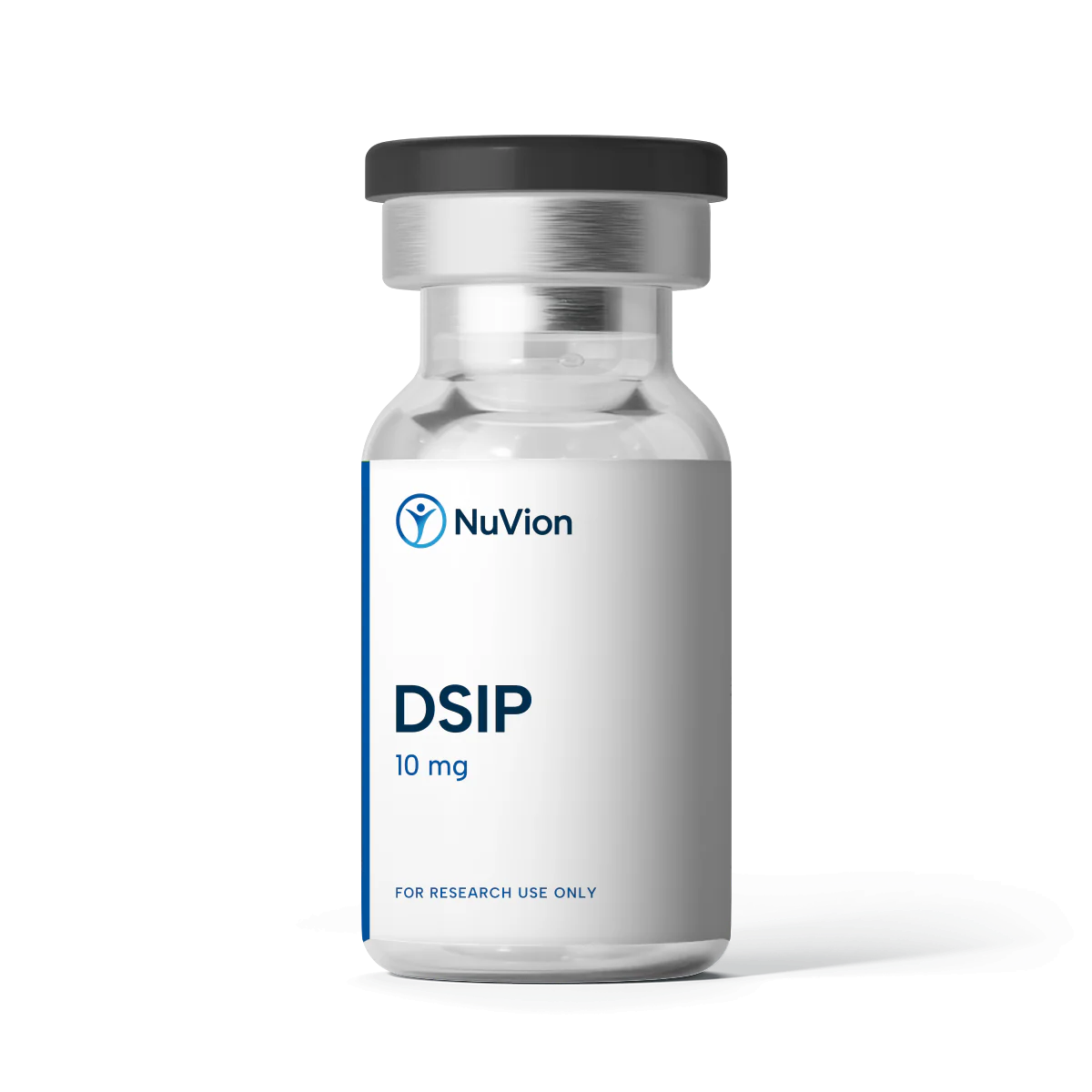
DSIP, delta sleep-inducing peptide, is a nonapeptide with the sequence Trp-Ala-Gly-Gly-Asp-Ala-Ser-Gly-Glu, first isolated from cerebral venous blood of rabbits in the 1970s and since found across a wide range of vertebrate tissue. At nine residues and 848 g/mol it is a small, highly polar neuropeptide used in neuronal and neuroendocrine culture to study glutamatergic and adrenergic signalling. NuVion supplies DSIP as a laboratory chemical for in vitro research use only.
Key facts
| Type | Naturally occurring neuropeptide |
| Amino acid count | 9 |
| Sequence | H-Trp-Ala-Gly-Gly-Asp-Ala-Ser-Gly-Glu-OH |
| Molecular formula | C35H48N10O15 |
| Molecular weight | 848.8 g/mol |
| CAS number | 62568-57-4 |
| Synonyms | Delta sleep-inducing peptide, DSIP |
| Supplied form | Lyophilised powder in a sealed vial |

Structure and chemistry
DSIP is a linear nonapeptide with free termini and no disulfide bond. Its composition is unusual for a bioactive neuropeptide: three glycines and two alanines make up more than half the sequence, which leaves the backbone highly flexible and gives the peptide no stable secondary structure in aqueous solution. Nuclear magnetic resonance and circular dichroism work describe it as a disordered ensemble that samples turn-like conformations transiently. The only bulky side chain is the N-terminal tryptophan, and the two acidic residues, aspartate at position five and glutamate at position nine, give the peptide a net charge near minus two at neutral pH.
The tryptophan is the analytical handle. It absorbs at 280 nm and fluoresces near 350 nm, so the peptide can be followed by ultraviolet detection during RP-HPLC and quantified by absorbance without derivatisation. That same residue is the main chemical liability, susceptible to oxidation and to photodegradation, which is why solutions are kept out of the light. The N-terminal amine is free, so DSIP is a substrate for aminopeptidases and is short-lived in serum-containing medium, with reported half-lives in the range of minutes in plasma. Several analogues have been made to address that, including phosphorylated DSIP, in which the serine at position seven carries a phosphate group and which behaves differently in binding assays.
The peptide is freely soluble in water at neutral pH. Its low hydrophobicity means it elutes early on reversed-phase columns, and its small mass and lack of basic residues make it a poor ioniser in positive mode mass spectrometry, so negative mode is often preferred for LC-MS quantification.
Mechanism of action
No high-affinity receptor for DSIP has been cloned, and after five decades of work the molecular target remains undefined. The mechanistic literature is therefore built on measured cellular responses instead of on a receptor-ligand model. In neuronal culture and in synaptosomal preparations, DSIP has been reported to modulate glutamatergic signalling, with effects on NMDA receptor currents and on calcium influx measured by patch clamp and by fluorescent calcium imaging. Separate work describes interaction with adrenergic signalling, followed as changes in cyclic AMP accumulation and in catecholamine release from cultured chromaffin or neuroendocrine cells.
A second area concerns neuroendocrine output. In pituitary cell culture, DSIP has been reported to alter secretion of several anterior pituitary hormones measured by immunoassay in conditioned medium, and to influence the release of hypothalamic factors in isolated tissue preparations. Because the peptide is degraded rapidly and has no identified receptor, the field has placed weight on structure-activity work with analogues, on demonstrating specificity through scrambled-sequence controls, and on separating direct action from effects secondary to amino acid release during degradation. Those controls are the practical core of experimental design with this compound.
Research applications
- Electrophysiology in primary neurons or brain slice preparations: NMDA receptor current measurement by whole-cell patch clamp with scrambled-sequence controls.
- Calcium imaging in neuronal or neuroendocrine culture using Fura-2 or a genetically encoded indicator.
- Cyclic AMP accumulation assays in cells expressing adrenergic receptors, following second messenger response.
- Hormone secretion assays in pituitary cell culture, quantifying conditioned medium by ELISA or radioimmunoassay.
- Structure-activity studies comparing native DSIP, phosphorylated DSIP and scrambled-sequence analogues under identical conditions.
- Peptidase stability work in serum or cell lysate, following loss of the parent by LC-MS in negative ion mode.
DSIP sits in NuVion’s Neuroscience category with the other neuroactive research peptides.
Handling in the laboratory
DSIP is supplied lyophilised and is reconstituted with bacteriostatic water added slowly down the wall of the vial and swirled gently until dissolved. The peptide is highly water-soluble and needs no organic co-solvent. The reconstitution calculator converts vial content and diluent volume into a stock concentration. Concentration in the stock can be checked directly by measuring absorbance at 280 nm against the tryptophan extinction coefficient, which is a useful cross-check that few peptides of this size allow.
Light protection matters more for DSIP than for most short peptides because of the tryptophan, so vials and stock solutions are kept in the dark and amber tubes are preferred for working aliquots. Unopened vials are kept sealed, dry and refrigerated as stated on the product documentation. Reconstituted solution is refrigerated, protected from light and used within the period given there, or aliquoted and frozen to avoid repeated freeze-thaw cycles. Given the short peptidase half-life, experiments in serum-containing medium usually include a parallel stability measurement so that exposure is known.
Testing and supply from NuVion
NuVion’s DSIP is manufactured at a GMP-audited facility and independently tested by Janoshik Analytical, with purity determined by RP-HPLC and identity confirmed by mass spectrometry. The Certificate of Analysis for a tested batch is published on the product page and in the COA library. The peptide is supplied lyophilised in sealed vials and dispatched from within Australia.
Related compounds
Other neuroactive peptides examined in comparable culture systems include Selank and Semax, both short regulatory peptides, and Pinealon, a tripeptide used in neuronal culture.
Frequently asked questions
What is DSIP used for in research?
It is used as a defined neuropeptide stimulus in electrophysiology and calcium imaging on neuronal preparations, in second messenger assays on adrenergic signalling, and in hormone secretion work on cultured pituitary cells. It is also a common subject for structure-activity comparison with its analogues.
Does DSIP have a known receptor?
No high-affinity receptor has been cloned for it. That absence shapes how the compound is studied, so experimental designs rely on scrambled-sequence controls, analogue comparison and stability measurement to establish that an observed response is sequence-specific.
Is DSIP a therapeutic good in Australia?
No. NuVion’s DSIP is a laboratory chemical for in vitro research. It is not included in the Australian Register of Therapeutic Goods, has not been assessed by the Therapeutic Goods Administration, and is not for human or veterinary use.
How should DSIP be stored?
Lyophilised vials are kept sealed, dry, protected from light and refrigerated per the product documentation. Reconstituted solution is refrigerated, kept dark and used within the stated period, or aliquoted and frozen. Light protection matters because of the tryptophan residue.
Research use only. This product is a laboratory chemical supplied for in vitro research. It is not included in the Australian Register of Therapeutic Goods and has not been assessed by the Therapeutic Goods Administration for quality, safety or efficacy. It is not for human or veterinary use, and nothing on this page is a representation about therapeutic use.