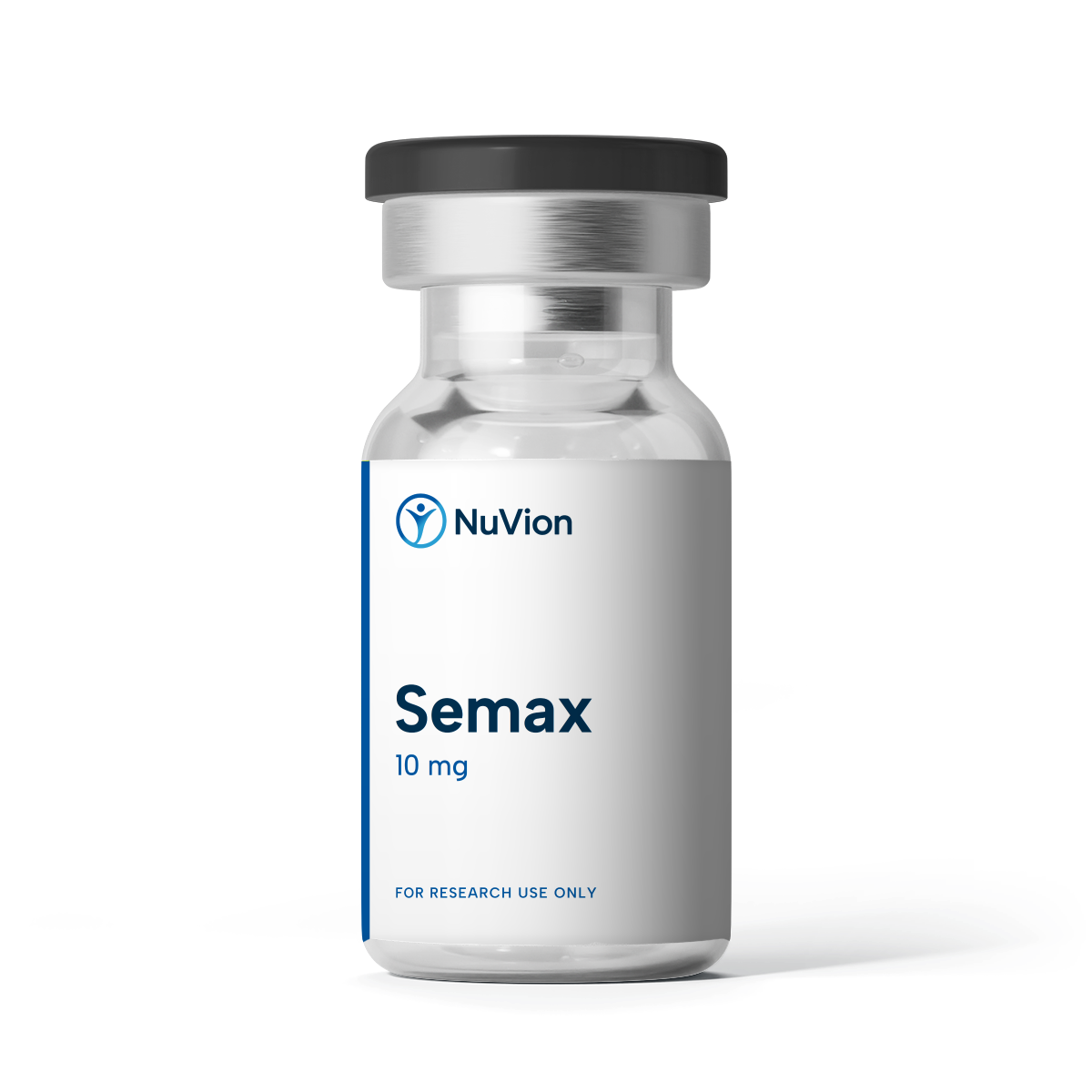

Semax is a modified ACTH (4-10) fragment with improved resistance to enzymatic degradation. It is used in neuronal culture and brain slice preparations to study BDNF expression and synaptic plasticity, and NuVion stocks it in Australia as a 10mg lyophilised vial.
- Modified ACTH (4-10) fragment with improved resistance to degradation
- Used in neuronal culture and brain slice preparations
- Applied in BDNF and neurotrophic factor expression assays
- Supplied lyophilised, purity by RP-HPLC and identity by mass spectrometry
Semax structure and research use
Semax has the sequence Met-Glu-His-Phe-Pro-Gly-Pro. The first four residues come from adrenocorticotropic hormone, positions 4 to 7, and the Pro-Gly-Pro tail was added to slow enzymatic breakdown. In the laboratory it is used in neuronal culture and brain slice preparations for work on BDNF expression and synaptic plasticity.
Semax research applications
- BDNF and NTRK2 transcript measurement by qPCR in primary cortical or hippocampal neuron culture and in glial culture
- TrkB autophosphorylation with ERK1/2, Akt and CREB phosphorylation by Western blot, run with TrkB kinase inhibitor controls
- Neurite outgrowth and differentiation assays in PC12 and SH-SY5Y cells, scored by image analysis
- Melanocortin receptor binding and cAMP assays, with Semax as the structurally related inactive comparator to alpha-MSH
Semax key facts
| Type | Synthetic peptide, ACTH(4-7) analogue with a C-terminal Pro-Gly-Pro extension |
|---|---|
| Amino acid count | 7 |
| Sequence | H-Met-Glu-His-Phe-Pro-Gly-Pro-OH (MEHFPGP) |
| Also known as | ACTH(4-7)PGP, Met-Glu-His-Phe-Pro-Gly-Pro |
| Vial size | 10mg, lyophilised |
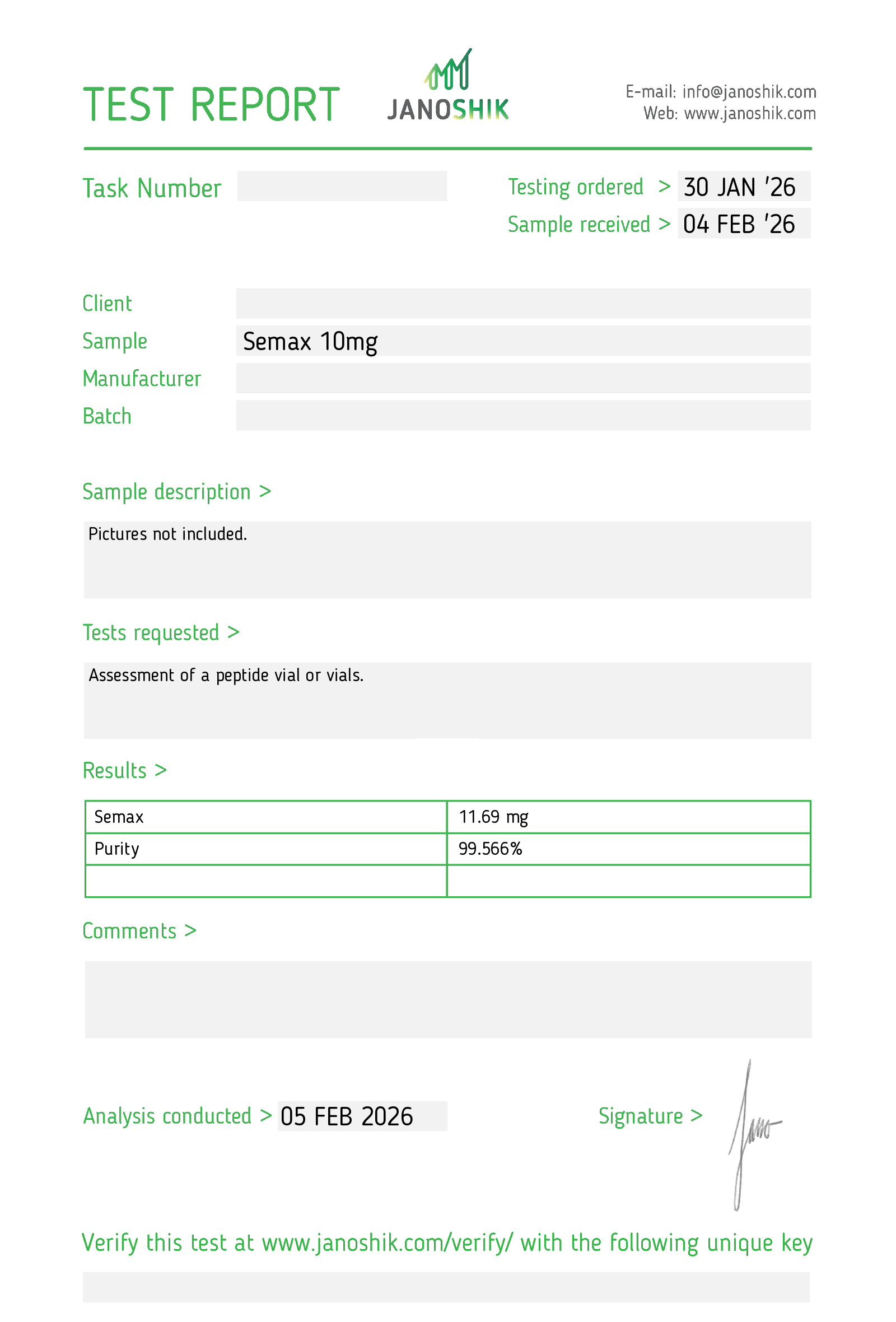
| Purity | 99.57% by RP-HPLC, Janoshik Analytical |
| Analysed | 5 February 2026 |
Research profile: Semax: structure, mechanism and research use
Independent test: a sample of this product was analysed by Janoshik Analytical on 5 February 2026, purity 99.57% by RP-HPLC. The certificate is shown in the lab band on this page.