
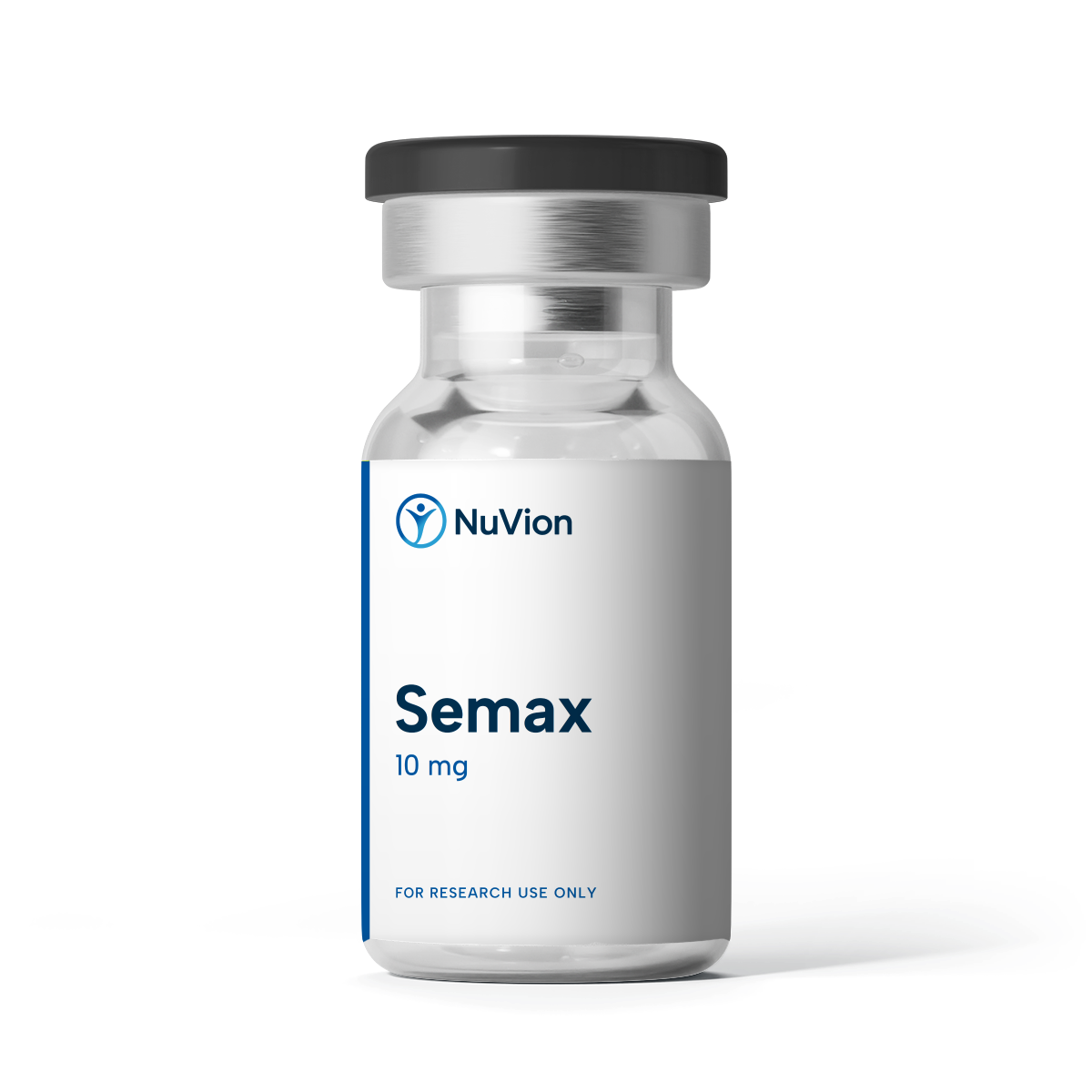
Semax and Selank are both synthetic heptapeptides that end in the same three residues, which is why they are so often mentioned together. The first four residues are where they part. Semax starts with a fragment of adrenocorticotropic hormone, and Selank starts with tuftsin, a fragment of immunoglobulin G. This page compares their structure and the laboratory work each is used for.
At a glance
| Semax | Selank | |
|---|---|---|
| Type | Synthetic heptapeptide | Synthetic heptapeptide |
| Sequence | Met-Glu-His-Phe-Pro-Gly-Pro | Thr-Lys-Pro-Arg-Pro-Gly-Pro |
| Parent sequence | ACTH (4-7) | Tuftsin, from the heavy chain of immunoglobulin G |
| Shared element | C-terminal Pro-Gly-Pro | C-terminal Pro-Gly-Pro |
| Common cell models | Neuronal and glial cultures | Hippocampal and cortical cultures |
| NuVion vial size | 10mg | 10mg |
Structure
Each peptide is seven amino acids long and is built in two parts. The first four residues carry the activity of the parent sequence. In Semax that is Met-Glu-His-Phe, residues 4 to 7 of ACTH, a stretch with no hormonal activity at the adrenal cortex. In Selank it is Thr-Lys-Pro-Arg, the tetrapeptide tuftsin.
The last three residues, Pro-Gly-Pro, are the same in both. Short peptides are cut quickly by peptidases in culture medium and serum, and the proline-rich tail was added to slow that breakdown.
Mechanism at the cell level
Semax is used in neuronal culture to study neurotrophin expression, in particular transcription of brain-derived neurotrophic factor and its receptor TrkB. Selank is used in hippocampal and cortical cultures to study GABAergic signalling and cytokine gene expression. The two share a tail and act on different systems, so they are treated as separate tools.
Where each is used in research
- Semax: BDNF and TrkB expression assays in neuronal cultures
- Semax: peptidase stability studies on the Pro-Gly-Pro tail
- Selank: GABAergic signalling assays in hippocampal and cortical cultures
- Selank: cytokine expression readouts in cell-based models
Supplied by NuVion
NuVion stocks Semax and Selank in Australia as 10mg lyophilised vials. Both come together in separate vials as the Semax and Selank Pair and as part of the Neuropeptide Signalling Set. Published certificates are shown on each product page and in the COA library.
Frequently asked questions
What is the difference between Semax and Selank?
The first four residues. Semax is built on a fragment of ACTH and Selank on the immunoglobulin fragment tuftsin. Both carry the same Pro-Gly-Pro tail.
Why do both end in Pro-Gly-Pro?
The tail was added to slow enzymatic breakdown. Proline-rich sequences resist many peptidases, so the parent fragment lasts longer in solution.
Are Semax and Selank therapeutic goods in Australia?
No. NuVion’s Semax and Selank are laboratory chemicals for in vitro research. They are not included in the Australian Register of Therapeutic Goods, have not been assessed by the Therapeutic Goods Administration, and are not for human or veterinary use.
Research use only. These products are laboratory chemicals supplied for in vitro research. They are not included in the Australian Register of Therapeutic Goods and have not been assessed by the Therapeutic Goods Administration for quality, safety or efficacy. They are not for human or veterinary use, and nothing on this page is a representation about therapeutic use.