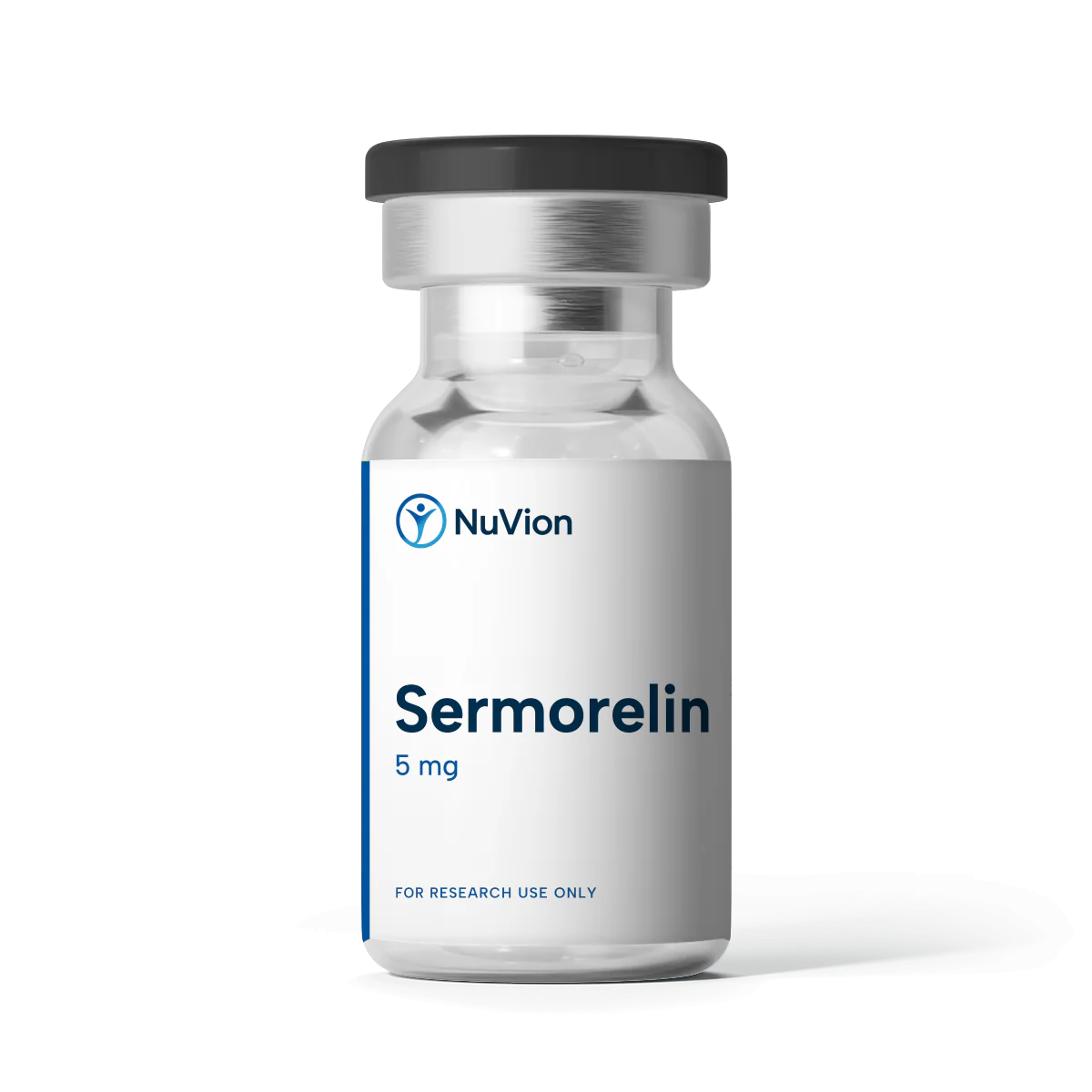
Sermorelin is the synthetic, C-terminally amidated N-terminal 29-residue fragment of human growth hormone-releasing hormone, written GRF(1-29)-NH2 or GHRH(1-29)-NH2. It is a full agonist at the GHRH receptor and is used as the reference ligand in GHRH receptor pharmacology and in pituitary somatotroph cell models. NuVion supplies Sermorelin as a laboratory chemical for in vitro research use only.
Key facts
| Type/class | Synthetic peptide, GHRH fragment, GHRH receptor agonist |
| Amino acid count | 29 |
| Sequence | Tyr-Ala-Asp-Ala-Ile-Phe-Thr-Asn-Ser-Tyr-Arg-Lys-Val-Leu-Gly-Gln-Leu-Ser-Ala-Arg-Lys-Leu-Leu-Gln-Asp-Ile-Met-Ser-Arg-NH2 (YADAIFTNSYRKVLGQLSARKLLQDIMSR-NH2) |
| Molecular formula | C149H246N44O42S |
| Molecular weight | 3357.9 g/mol (free peptide) |
| CAS number | 86168-78-7 |
| Synonyms | GRF(1-29)-NH2, GHRH(1-29)-NH2, hGRF(1-29), sermorelin acetate (salt form) |
| Supplied form | Lyophilised powder in a sealed vial |

Sermorelin
$79 AUD
View productResearch use only. Not for human or veterinary use.
Structure and chemistry
Native human GHRH is a 44-residue amidated peptide processed from a 108-residue preprohormone in hypothalamic arcuate neurons. When GHRH was first isolated in 1982, truncation studies showed that residues 1 to 29 carry the full receptor-activating activity and that the C-terminal 30 to 44 segment can be removed without loss of potency in pituitary cell assays. Sermorelin is that 1 to 29 fragment with the native L-amino acid sequence and a C-terminal amide in place of the free carboxylate, which mirrors the amidated C-terminus of the parent hormone and protects the chain from carboxypeptidases.
In water the peptide is largely unstructured. In membrane-mimicking environments it folds into an amphipathic alpha-helix over roughly residues 6 to 28, the conformation seen in the cryo-EM structure of GHRH bound to its receptor. The helix docks along the extracellular domain of the receptor while the N-terminal residues, Tyr1 and Ala2 in particular, insert into the transmembrane bundle. This two-site binding mode is shared across the class B1 (secretin-family) receptors and is why the first two residues cannot be removed without abolishing activation.
Four positions in the sequence are chemically labile, and they explain the design of the later analogues. The Tyr1-Ala2 bond is cleaved by dipeptidyl peptidase IV (DPP-IV), producing GRF(3-29), which does not activate the receptor; in serum-containing medium this reaction limits the intact half-life to minutes. Asn8 deamidates to Asp or isoAsp, Asp3 can isomerise through a succinimide intermediate, and Met27 oxidises to methionine sulfoxide, which lowers receptor affinity. Modified GRF(1-29), sold as CJC-1295 No DAC, substitutes D-Ala2, Gln8, Ala15 and Leu27 to remove these four liabilities. Sermorelin, with the native sequence, is therefore the compound used when the endogenous ligand’s own behaviour is the subject of the experiment.
Mechanism of action
The GHRH receptor (GHRHR) is a class B1 G protein-coupled receptor expressed almost exclusively on pituitary somatotrophs. Sermorelin binds it with nanomolar affinity and couples it to Gs. Adenylyl cyclase is activated, intracellular cAMP rises, and protein kinase A (PKA) phosphorylates the transcription factor CREB. Phosphorylated CREB drives transcription of the pituitary-specific factor Pit-1 (POU1F1), and Pit-1 together with CREB increases transcription of the GH1 gene, so the peptide raises both the synthesis and the stored pool of growth hormone in somatotroph cultures.
Release of stored hormone is a separate, faster event. PKA phosphorylates L-type voltage-gated calcium channels and modulates sodium and potassium conductances, the somatotroph depolarises, calcium enters, and the rise in cytosolic calcium triggers exocytosis of GH-containing secretory granules within minutes. In primary pituitary cell cultures the response is measured as GH in the medium by ELISA, and it is blocked by the GHRHR antagonist analogues such as [N-Ac-Tyr1, D-Arg2]-GRF(1-29)-NH2 and by inhibitors of adenylyl cyclase or PKA. The cAMP pathway also feeds ERK1/2 phosphorylation through PKA and Rap1, which is the route linked to somatotroph proliferation in culture.
Two other inputs are usually considered alongside it. Somatostatin, acting through the Gi-coupled receptors SSTR2 and SSTR5, lowers cAMP and hyperpolarises the cell, and it suppresses the Sermorelin response when the two are co-applied. Ghrelin and synthetic growth hormone secretagogues act through the Gq-coupled GHS-R1a to raise inositol trisphosphate and calcium, and their combination with a GHRHR agonist gives a larger response than either alone because the two pathways converge on calcium-dependent exocytosis from different directions.
Research applications
Sermorelin is listed in NuVion’s Growth Hormones category. Typical in vitro contexts include:
- cAMP accumulation (HTRF or ELISA) and CRE-luciferase reporter assays in HEK293 or CHO cells expressing recombinant GHRHR, with Sermorelin as the reference full agonist for EC50 determination
- Competitive radioligand binding against iodinated GRF(1-29) or GHRH on GHRHR-expressing membranes to derive Ki values for new analogues and antagonists
- GH release from primary pituitary cell cultures measured by ELISA, including co-application with somatostatin, ghrelin or GHS-R1a agonists such as Ipamorelin
- Calcium imaging with Fura-2 or Fluo-4 in somatotroph-enriched cultures to resolve the depolarisation and calcium-entry phase of secretion
- Stability studies: incubation in serum or with purified DPP-IV followed by LC-MS to quantify GRF(3-29), sulfoxide and deamidated species, and comparison with Modified GRF(1-29)
- RP-HPLC method development for a mid-length amidated peptide with a single oxidisable methionine
Handling in the laboratory
Reconstitute the lyophilised powder with bacteriostatic water, letting the water run down the inside of the vial and swirling instead of shaking, since the amphipathic helix can foam and aggregate at an air-water interface. The reconstitution calculator gives the volume for a chosen stock concentration. Because of the Met27 residue, keep the solution away from light and avoid repeated exposure to air; aliquoting the stock once and keeping the aliquots refrigerated limits both oxidation and freeze-thaw cycling. Keep the sealed vial dry, away from light and refrigerated as described in the product documentation, and use reconstituted solution within the period the documentation specifies. For assays in serum-containing medium, a DPP-IV inhibitor such as diprotin A is often included so that the intact peptide, not GRF(3-29), is what the cells see. Each lot is characterised by RP-HPLC for purity and by mass spectrometry for identity; the methionine sulfoxide impurity appears as a +16 Da species and as an earlier-eluting peak on a C18 column.
Testing and supply from NuVion
NuVion’s Sermorelin comes from GMP-audited manufacture and is supplied lyophilised in sealed vials. Most batches are independently tested by Janoshik Analytical for purity by RP-HPLC and identity by mass spectrometry, and the Certificate of Analysis for a tested batch is published on the product page and in the COA library. Orders are dispatched from within Australia.
Related compounds
CJC-1295 No DAC is the four-substitution Modified GRF(1-29) analogue that resists DPP-IV and oxidation, and Ipamorelin is the pentapeptide GHS-R1a agonist most often paired with a GHRHR agonist in somatotroph co-stimulation experiments.
Frequently asked questions
What is Sermorelin used for in research?
It is the standard native-sequence agonist for the GHRH receptor. Laboratories use it to define receptor pharmacology in transfected cell lines, to stimulate GH synthesis and release in pituitary cell cultures, and as the unmodified comparator in stability and structure-activity studies of GHRH analogues.
How does Sermorelin differ from CJC-1295 No DAC?
Both are 29-residue amidated GHRH fragments acting at the same receptor. Sermorelin has the native sequence, so it is cleaved by DPP-IV at Ala2 and can oxidise at Met27. CJC-1295 No DAC carries D-Ala2, Gln8, Ala15 and Leu27 substitutions that remove those liabilities, which makes it the more stable choice for long incubations and Sermorelin the correct choice when the native ligand’s behaviour is the question.
Is Sermorelin a therapeutic good in Australia?
No. Sermorelin from NuVion is a laboratory chemical for in vitro research. It is not included in the Australian Register of Therapeutic Goods and has not been assessed by the TGA. It is not for human or veterinary use.
How should Sermorelin be stored?
Keep the lyophilised powder sealed, dry, away from light and refrigerated according to the product documentation. After reconstitution with bacteriostatic water, refrigerate the solution, protect it from light and air, and use it within the period stated in the documentation.
Research use only. This product is a laboratory chemical supplied for in vitro research. It is not included in the Australian Register of Therapeutic Goods and has not been assessed by the Therapeutic Goods Administration for quality, safety or efficacy. It is not for human or veterinary use, and nothing on this page is a representation about therapeutic use.