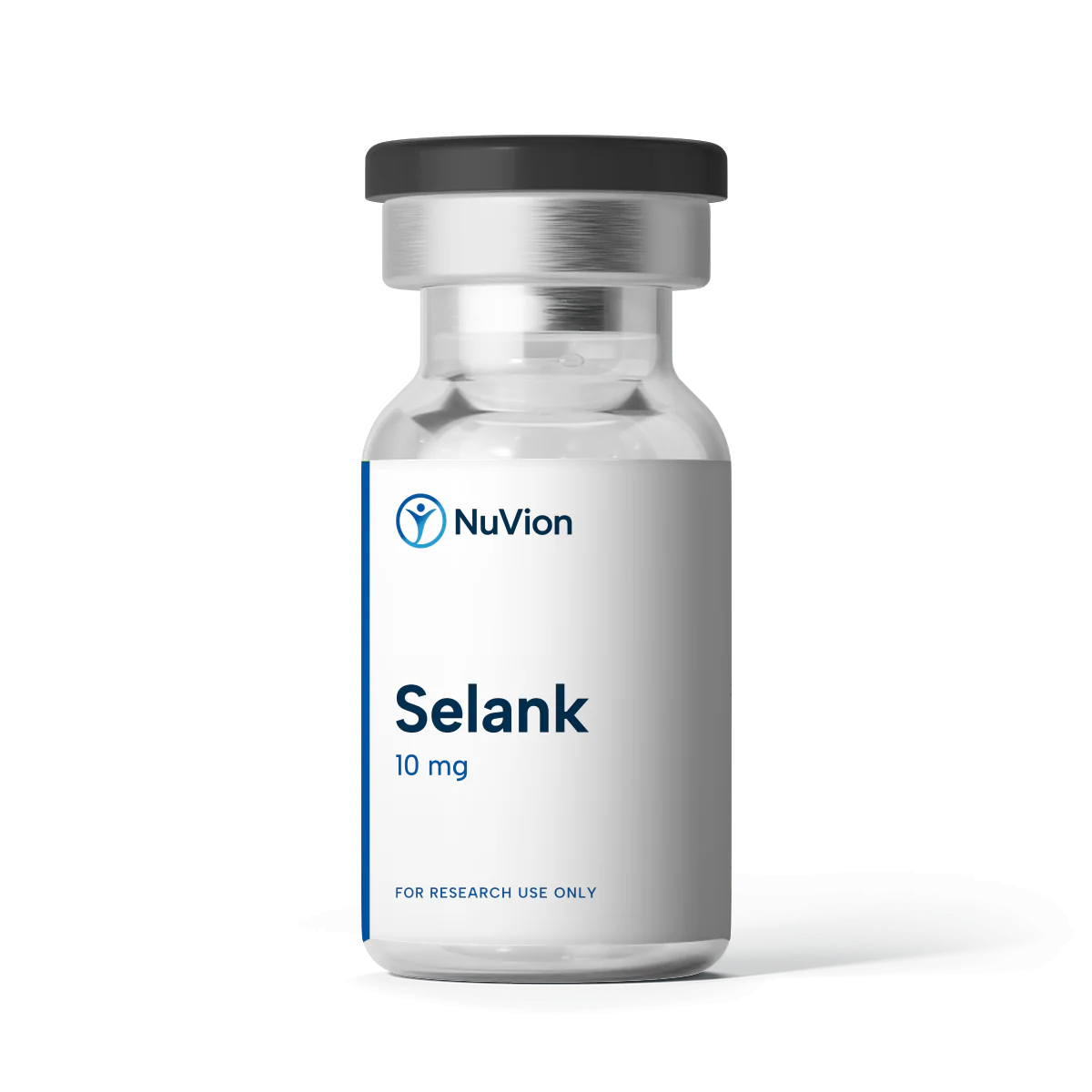
Selank is a synthetic heptapeptide, Thr-Lys-Pro-Arg-Pro-Gly-Pro, made by adding the tripeptide Pro-Gly-Pro to the C-terminus of tuftsin. It is used in the laboratory as a tool compound in GABA receptor radioligand binding work, in enzyme assays on enkephalin-degrading peptidases, and in peptide stability and transport studies. NuVion supplies Selank as a laboratory chemical for in vitro research use only.
Key facts
| Type | Synthetic peptide, tuftsin analogue with a C-terminal Pro-Gly-Pro extension |
| Amino acid count | 7 |
| Sequence | H-Thr-Lys-Pro-Arg-Pro-Gly-Pro-OH (TKPRPGP) |
| Molecular formula | C33H57N11O9 |
| Molecular weight | Approximately 751.9 g/mol |
| CAS number | 129954-34-3 |
| Synonyms | Tuftsin-PGP, Thr-Lys-Pro-Arg-Pro-Gly-Pro |
| Supplied form | Lyophilised powder in a sealed vial |

Structure and chemistry
Tuftsin is the tetrapeptide Thr-Lys-Pro-Arg, a sequence carried within the CH2 domain of the immunoglobulin G heavy chain and released from it by proteolysis. Selank keeps that tetrapeptide intact and extends it with Pro-Gly-Pro, a glyproline motif of the kind found in collagen breakdown products. The same Pro-Gly-Pro cap is used on Semax, and it serves the same purpose in both molecules: prolines at and near the C-terminus obstruct carboxypeptidases and many endopeptidases, so the heptapeptide persists far longer than the parent tetrapeptide in serum-containing medium or a tissue homogenate assay.
The composition is strongly basic. A lysine and an arginine supply two positively charged side chains, there is no aspartate or glutamate to offset them, and only the C-terminal carboxylate carries negative charge, so the peptide is net positive across the usual buffer range and highly water-soluble. Three of the seven residues are proline, which restricts backbone rotation and gives the molecule a rigid, extended shape with little capacity to fold. There is no cysteine, so no disulfide chemistry, and no methionine, so oxidation is not a normal degradation route. The sequence has no tryptophan, tyrosine or phenylalanine, so there is no absorbance at 280 nm and concentration has to be set at 214 nm, gravimetrically, or from the certificate value.
One structural detail changes how the two molecules behave in binding work. Tuftsin ends in a free arginine, which fits the C-end rule (CendR) motif that the b1 domain of neuropilin-1 both recognises and requires. In Selank the arginine is internal, capped by Pro-Gly-Pro, so the intact heptapeptide presents no CendR terminus and would need proteolytic release of tuftsin before neuropilin-1 came into play. That difference has to be accounted for when the two peptides are compared in a binding experiment.
Mechanism of action
The interaction studied most often is with the GABA-A receptor. GABA-A receptors are pentameric ligand-gated chloride channels, typically two alpha, two beta and one gamma subunit, with the orthosteric GABA sites at alpha-beta interfaces and the classical benzodiazepine site at the alpha-gamma interface. In radioligand binding assays on synaptic membrane preparations, Selank shifts the binding of tritiated GABA in a concentration-dependent way consistent with positive allosteric modulation, and it alters binding at the benzodiazepine site as well. When Selank is combined with a benzodiazepine site ligand the effect on binding is not additive, which indicates its site is distinct from the benzodiazepine site while overlapping with it in the conformational sense. The subunit selectivity of that modulation is what these assays are usually designed to resolve, using recombinant receptors of defined subunit composition expressed in HEK293 or Xenopus oocyte systems alongside membrane preparations.
The second characterised activity is enzymatic. Enkephalins are pentapeptides degraded by aminopeptidase N, neprilysin and angiotensin-converting enzyme, and their turnover in a cell-free assay can be tracked by LC-MS or with fluorogenic substrates. Selank slows this degradation, so the measured half-life of Leu-enkephalin in plasma-based and purified-enzyme assays increases in its presence. Whether the mechanism is direct enzyme inhibition or competition as an alternative substrate is a question the kinetics are set up to answer: substrate competition and true inhibition give different patterns in Lineweaver-Burk or global fitting analysis. Because enkephalins are the endogenous ligands at delta and mu opioid receptors, slowing their breakdown alters the concentration of ligand available at those receptors in a tissue preparation, and this is the proposed indirect link to opioid receptor signalling.
Binding work with radiolabelled Selank shows specific, saturable association with neural plasma membrane fractions, which points to a membrane binding site, though no receptor has been identified for the intact peptide. Transcript-level studies in cultured cells report changes in the expression of genes for neurotrophins, interferons and enzymes of monoamine metabolism after exposure. Those observations sit downstream of an undefined initiating event, so they describe a pathway readout and not a mechanism.
Research applications
Selank sits in NuVion’s Neuroscience category. Typical study contexts include:
- Radioligand binding assays on synaptic membrane preparations using tritiated GABA, muscimol or flunitrazepam, with and without benzodiazepine site ligands
- Electrophysiology on recombinant GABA-A receptors of defined subunit composition, to test subunit selectivity of allosteric modulation
- Peptidase kinetics: Leu-enkephalin degradation by aminopeptidase N, neprilysin and ACE, followed by LC-MS or fluorogenic substrate assays
- Stability comparisons between tuftsin and the Pro-Gly-Pro-extended sequence in serum-containing medium and tissue homogenate
- Neuropilin-1 b1 domain binding assays, where tuftsin and Selank separate a free CendR terminus from a capped one
- Gene expression profiling by qPCR or RNA sequencing in neuronal cell culture, and ion-pair RP-HPLC method development for a very hydrophilic basic peptide
Handling in the laboratory
Selank is supplied as a lyophilised powder in a sealed vial. Reconstitute with bacteriostatic water down the vial wall; the volume for a working concentration can be calculated with the reconstitution calculator. The peptide is basic and very hydrophilic, so it goes into water and neutral buffers immediately and needs no organic co-solvent. Basic peptides adsorb to glass and to some plastics at low concentration, so low-binding tubes and tips are worth using for dilute working solutions. Keep the sealed vial dry and away from light, refrigerated as stated in the product documentation. Refrigerate the reconstituted solution and use it within the period on the documentation, dividing it into single-use aliquots so the stock is not put through repeated freeze-thaw. On a reversed-phase column the peptide elutes very early, so an ion-pairing reagent is normally needed for retention. The compound is characterised by RP-HPLC for purity and by mass spectrometry for identity.
Testing and supply from NuVion
NuVion’s Selank comes from GMP-audited manufacture and is independently tested by Janoshik Analytical. Most batches are tested, and the Certificate of Analysis for a tested batch, giving RP-HPLC purity and mass spectrometry identity, is published on the Selank product page and in the certificates of analysis library. It is supplied lyophilised in sealed vials and dispatched from within Australia.
Related compounds
Semax is the closest structural relative in the same category, another short peptide carrying the same Pro-Gly-Pro cap but built on an ACTH fragment instead of tuftsin. Pinealon, the tripeptide Glu-Asp-Arg, is used in gene expression studies in neuronal cell models.
Frequently asked questions
What is Selank used for in research?
It is used in GABA-A receptor radioligand binding and electrophysiology work as an allosteric modulator, and in enzyme assays measuring the degradation of Leu-enkephalin by peptidases. It also serves as a stability comparator against tuftsin and as a model basic peptide in chromatography method development.
How does Selank differ from tuftsin?
Selank is tuftsin with Pro-Gly-Pro attached at the C-terminus. The extension slows enzymatic breakdown, and it also caps the free C-terminal arginine that tuftsin uses to engage the b1 domain of neuropilin-1, so the two peptides are not interchangeable in receptor binding assays.
Is Selank a therapeutic good in Australia?
No. NuVion supplies Selank as a laboratory chemical for in vitro research, and it is not for human or veterinary use. The regulatory position is stated in the research use only notice at the end of this article.
How should Selank be stored?
Keep the sealed vial of lyophilised powder dry, away from light and refrigerated as stated in the product documentation. After reconstitution with bacteriostatic water, refrigerate the solution and use it within the period on the documentation. Aliquot for single use, and use low-binding labware for dilute solutions.
Research use only. This product is a laboratory chemical supplied for in vitro research. It is not included in the Australian Register of Therapeutic Goods and has not been assessed by the Therapeutic Goods Administration for quality, safety or efficacy. It is not for human or veterinary use, and nothing on this page is a representation about therapeutic use.