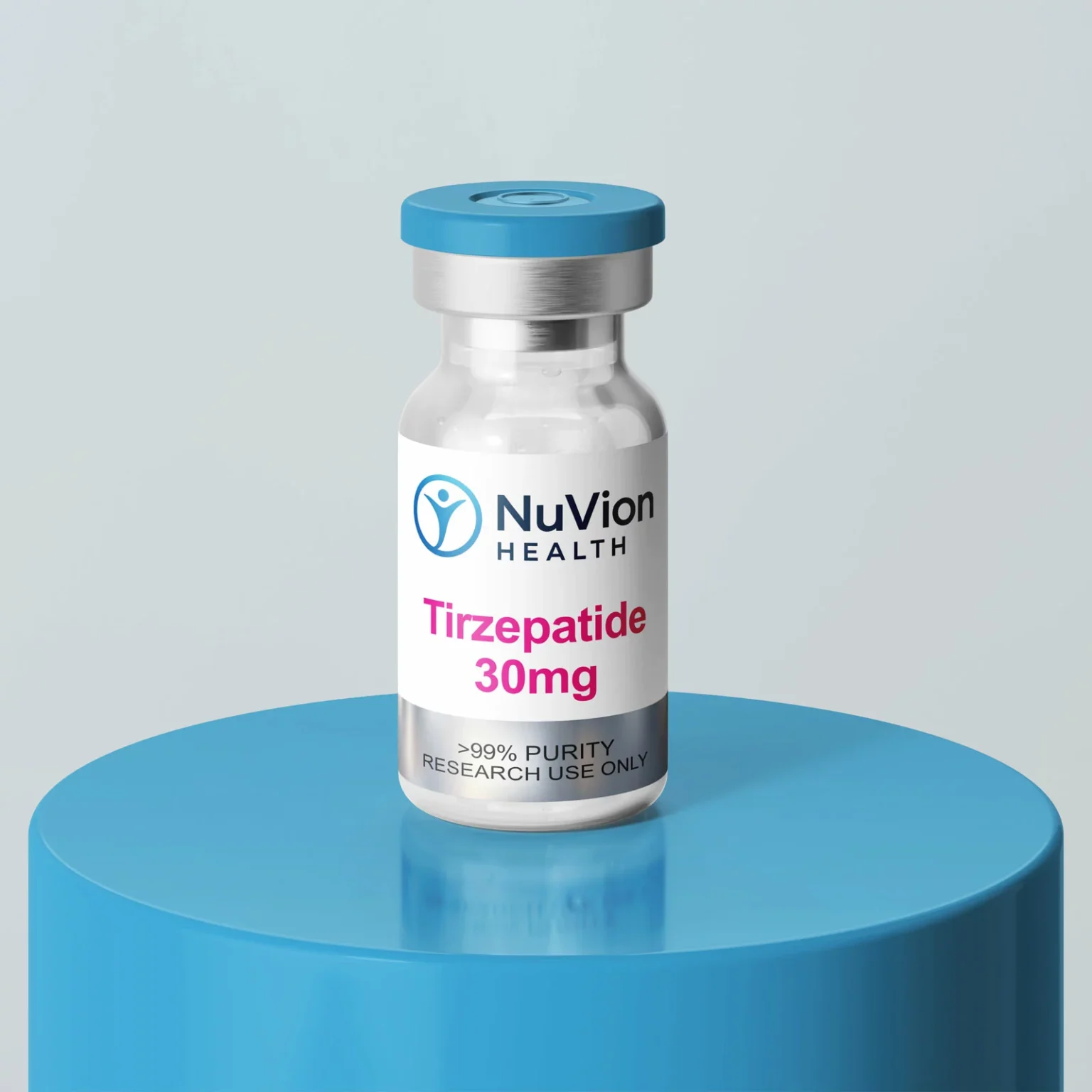
A peptide is a chain of amino acids joined by amide bonds, called peptide bonds in this context. Chains of up to about 50 residues are called peptides; longer chains that fold into a defined three-dimensional structure are called proteins. In the laboratory, synthetic peptides serve as receptor ligands, enzyme substrates, cell culture additives and analytical reference standards. NuVion Health supplies synthetic research peptides as laboratory chemicals for in vitro research use only.
Amino acids and the peptide bond
Every proteinogenic amino acid has the same core: a central alpha-carbon bonded to an amino group, a carboxyl group, a hydrogen atom and a side chain. Twenty side chains occur in ribosomally made peptides, from a single hydrogen in glycine to the indole ring of tryptophan, and the side chain sets the chemistry of the residue: hydrophobic, polar, acidic or basic. All except glycine are chiral and occur naturally as the L-enantiomer.
A peptide bond forms when the carboxyl group of one amino acid condenses with the amino group of the next, releasing a molecule of water. The product is an amide, and each amino acid in the chain is now a residue whose mass is that of the free amino acid minus 18.02 Da. The bond has partial double-bond character, so the six atoms around it are held in a plane and the chain rotates only about the bonds on either side of each alpha-carbon. Sequences are written from the N-terminus, which has a free amino group, to the C-terminus, which has a free carboxyl group.
Naming peptides by length
The simplest names count residues: a dipeptide has two, a tripeptide three, and so on up to a decapeptide with ten. Beyond that a chain is described by its residue count. Oligopeptide covers roughly two to twenty residues and polypeptide anything longer. The NuVion catalogue spans this range. Thymogen is the dipeptide Glu-Trp, KPV is the tripeptide Lys-Pro-Val, Epithalon is the tetrapeptide Ala-Glu-Asp-Gly, BPC-157 has 15 residues and LL-37 has 37. IGF-1 LR3 (83 residues) and recombinant growth hormone (191 residues) are proteins by any definition and sit in the same catalogue because the same handling applies. A residue has an average mass of about 110 Da, so a 30-residue peptide has a molecular weight near 3.3 kDa; the exact value comes from the sum of the residue formulas plus one water molecule.
Modifications found in synthetic peptides
Few research peptides are plain chains of standard residues.
- C-terminal amidation replaces the terminal carboxylic acid with a primary amide, removing a negative charge and blocking carboxypeptidases. Oxytocin, sermorelin (GRF(1-29)-NH2) and kisspeptin-10 are amidated.
- N-terminal acetylation caps the free amine and blocks aminopeptidases. Thymosin alpha-1 is acetylated at its N-terminus.
- D-amino acids and unnatural residues change conformation and resist proteolysis. Melanotan 1 carries D-phenylalanine at position 7 and norleucine at position 4; tirzepatide has 2-aminoisobutyric acid at positions 2 and 20.
- Cyclisation constrains the backbone. Oxytocin is closed by a disulfide between Cys1 and Cys6; Melanotan 2 is closed by a lactam between aspartate and lysine side chains.
- Lipidation attaches a fatty acid to a lysine side chain through a linker. Tirzepatide carries a C20 diacid on Lys20 via a gamma-glutamate and two short polyethylene glycol units, which gives it albumin-binding character.
- Metal complexation. GHK-Cu is the tripeptide Gly-His-Lys bound to a copper(II) ion through the N-terminal amine, the histidine imidazole and a backbone amide nitrogen.
How peptides behave in solution
Charge decides most of the solution behaviour of a peptide. At neutral pH the N-terminus, lysine and arginine carry positive charge, the C-terminus, aspartate and glutamate carry negative charge, and histidine sits close to its pKa. The pH at which these cancel is the isoelectric point, and solubility is lowest there. Hydrophobic residues drive self-association, and sequences rich in them can form beta-sheet aggregates in water. Short peptides are mostly disordered in solution and adopt a defined conformation only when bound to a receptor or a membrane. Chemical stability is limited by oxidation of methionine, cysteine and tryptophan, deamidation of asparagine, and hydrolysis by any protease present, so solutions are kept refrigerated and used within the period on the product documentation. The reconstitution calculator gives the concentration for a chosen volume of bacteriostatic water.
How synthetic peptides are made and checked
Research peptides are assembled by solid-phase peptide synthesis. The C-terminal residue is anchored to a resin, protected amino acids are coupled one at a time, and the finished chain is cleaved with trifluoroacetic acid, purified by preparative reversed-phase HPLC and freeze-dried, usually as the trifluoroacetate salt. Two tests characterise the product: analytical RP-HPLC, which reports purity as the percentage of total peak area in the main peak, and mass spectrometry, which confirms that the observed mass matches the mass calculated from the sequence. NuVion Health has its peptides tested independently by Janoshik Analytical. Most batches are tested, and the Certificate of Analysis for a tested batch is published on the product page and in the certificate library. Manufacture is GMP-audited, and the peptides are supplied lyophilised in sealed vials and dispatched from within Australia.
Where peptides are used in research
- Receptor pharmacology: binding assays with labelled ligands, and functional readouts such as cAMP accumulation, calcium flux and beta-arrestin recruitment in cells expressing the receptor.
- Cell culture: IGF-1 LR3 as a mitogen in serum-free media, and signalling peptides in migration, proliferation and differentiation assays.
- Microbiology: antimicrobial peptides such as LL-37 in minimum inhibitory concentration and membrane permeabilisation assays.
- Analytical chemistry: reference standards for HPLC and mass spectrometry method development.
Frequently asked questions
What separates a peptide from a protein?
Length and folding. Chains under about 50 residues are called peptides and rarely hold a stable tertiary structure on their own; longer chains that fold into a defined shape are called proteins.
How are research peptides supplied?
As a lyophilised powder in a sealed vial, usually as the trifluoroacetate salt. The powder is kept sealed, dry and away from light, refrigerated per the product documentation, and reconstituted with bacteriostatic water before use.
Are research peptides therapeutic goods in Australia?
No. NuVion Health supplies them as laboratory chemicals for in vitro research use only, and they are not sold or presented as therapeutic goods. The notice below sets out their regulatory position.
Browse the NuVion research peptide catalogue.
View productsResearch use only. This product is a laboratory chemical supplied for in vitro research. It is not included in the Australian Register of Therapeutic Goods and has not been assessed by the Therapeutic Goods Administration for quality, safety or efficacy. It is not for human or veterinary use, and nothing on this page is a representation about therapeutic use.