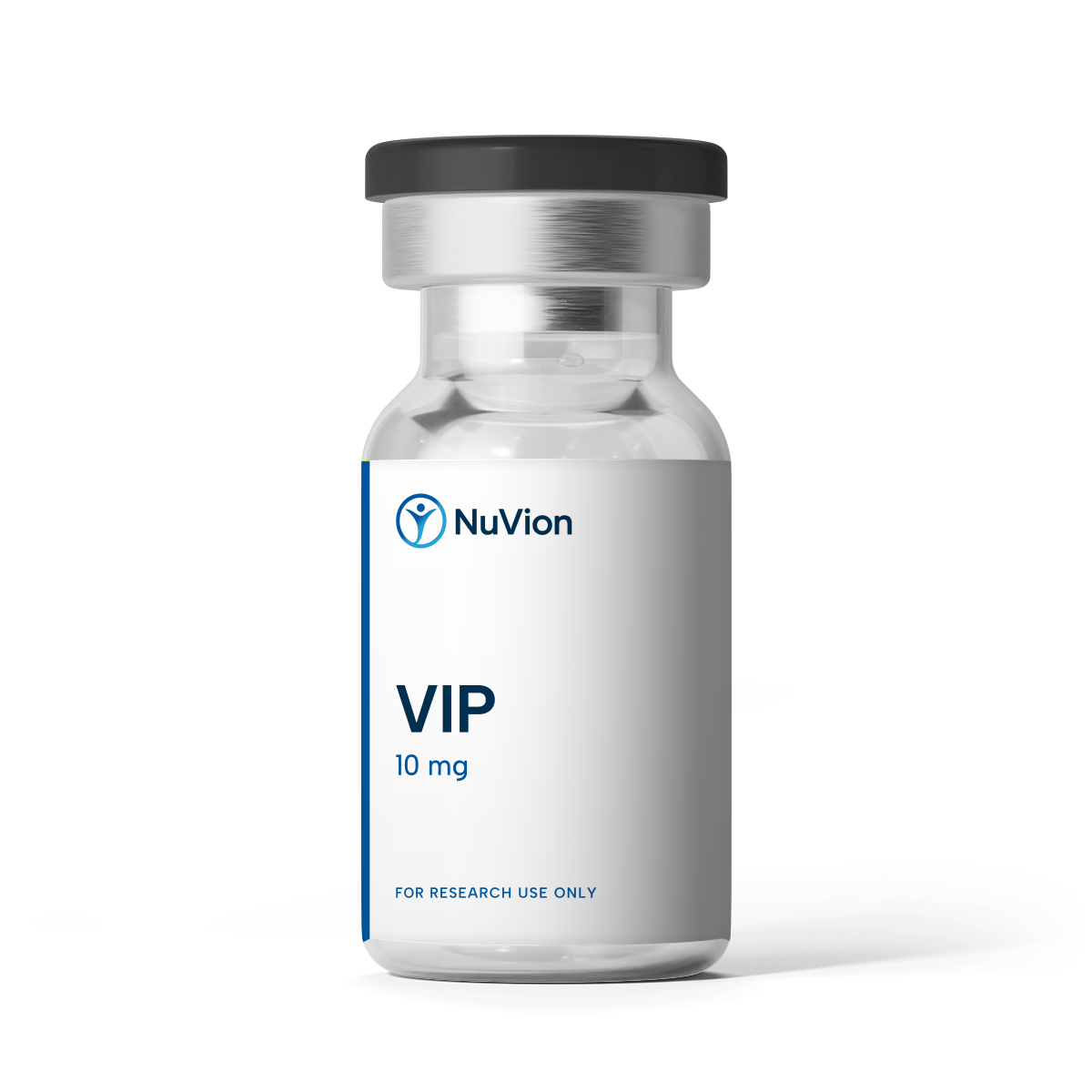

VIP is a 28 amino acid neuropeptide of the glucagon and secretin family, acting at the VPAC1 and VPAC2 receptors. It is used in immune cell, gastrointestinal and respiratory epithelial culture models to study receptor signalling and cytokine response, and NuVion stocks it in Australia as a 10mg lyophilised vial.
- 28 amino acid neuropeptide from the glucagon and secretin family
- Reference ligand at the VPAC1 and VPAC2 receptors
- Applied in cAMP accumulation and cytokine expression assays
- Supplied lyophilised, purity by RP-HPLC and identity by mass spectrometry
VIP structure and research use
VIP stands for vasoactive intestinal peptide. It is 28 amino acids long and belongs to the glucagon and secretin family, where its closest relative is PACAP. It acts at two G protein-coupled receptors, VPAC1 and VPAC2. In the laboratory it is used in immune cell, gastrointestinal and respiratory epithelial culture models for work on receptor signalling and cytokine response.
VIP research applications
- Cyclic AMP accumulation assays in VPAC1 or VPAC2 expressing cell lines, with VIP as the reference agonist
- Competition binding at VPAC1 and VPAC2 to determine affinity and selectivity of analogues under test
- Short-circuit current measurement in Ussing chambers on epithelial monolayers, following CFTR-dependent chloride transport
- Receptor internalisation and beta-arrestin recruitment by imaging or BRET, paired with PACAP to separate VPAC from PAC1 responses
VIP key facts
| Type | Naturally occurring neuropeptide |
|---|---|
| Amino acid count | 28 |
| Family | Secretin and glucagon peptide family |
| C-terminus | Amidated |
| Molecular formula | C147H238N44O42S |
| Molecular weight | 3326.8 g/mol |
| CAS number | 37221-79-7 |
| Vial size | 10mg, lyophilised |
| Purity | 99.51% by RP-HPLC, Janoshik Analytical |
| Analysed | 20 November 2025 |
Research profile: VIP: structure, mechanism and research use
Independent test: a sample of this product was analysed by Janoshik Analytical on 20 November 2025, purity 99.51% by RP-HPLC. The certificate is shown in the lab band on this page.