
Sale!

P21

Original price was: A$199.00.Current price is: A$149.00.

P21, a CNTF-derived tetrapeptide studied in neurogenesis and neuroscience research.

Research use only. Not for human or veterinary use.

In stock

All prices are in AUD. Ships from Australia with tracked express shipping, $15 flat, 1 to 2 business days, free on orders over $200. Research use only, not for human or veterinary use.

  • Testing status on this page
  • Same-day dispatch before 2pm
  • Dispatched from Australia
  • Card, Apple Pay & Google Pay

Research use only

Not for human or veterinary use.

Laboratory chemical

Supplied for in vitro research. We publish specifications and handling guidance only, with no protocols and no advice on use.

Not on the ARTG

Absent from the Australian Register of Therapeutic Goods and never evaluated by the TGA for safety, quality or efficacy. Absence from the register is not an approval and does not authorise any other use.

Who can order

You must be 18 or over and purchasing solely for lawful research.

What is P21?

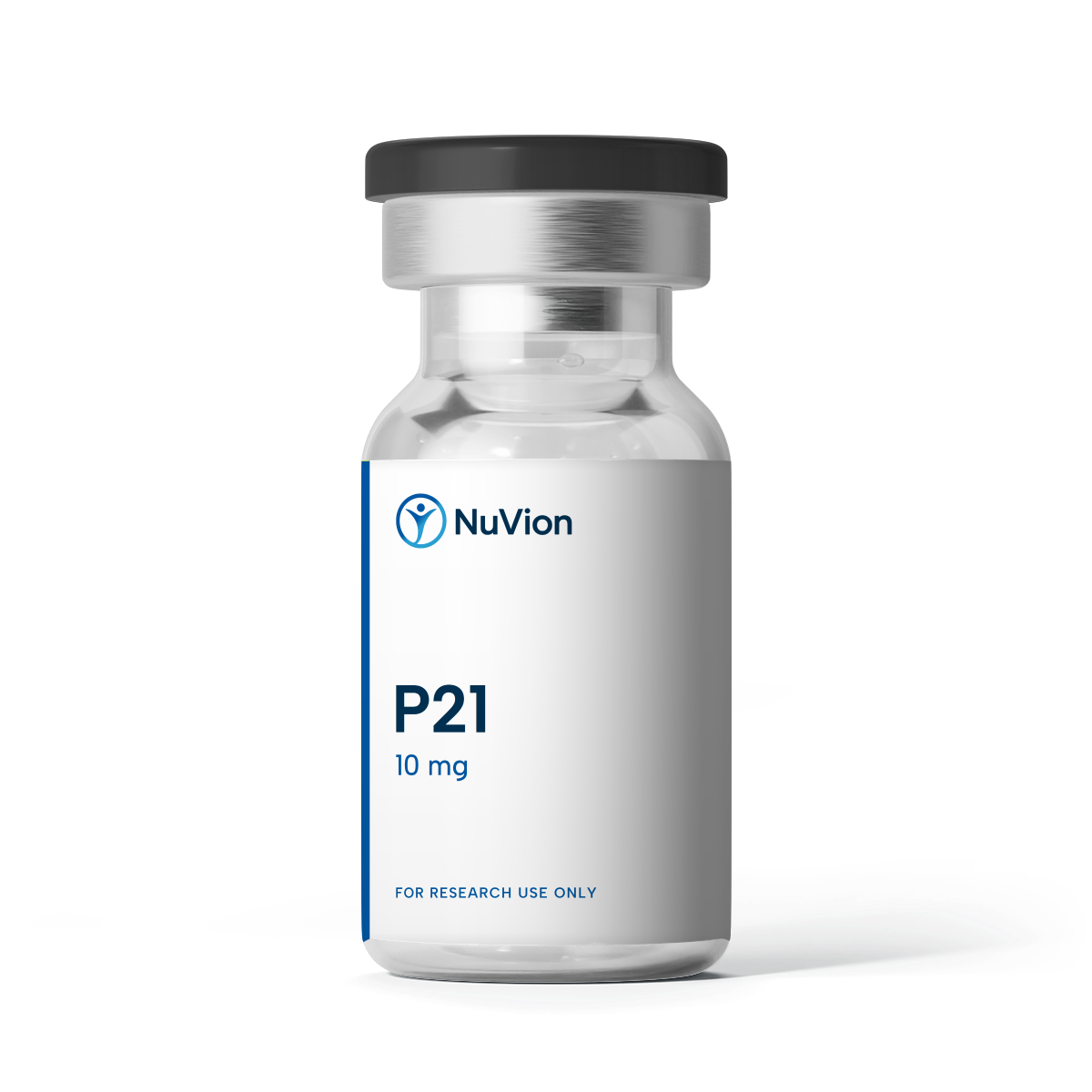
P21 is a synthetic CNTF-derived tetrapeptide carrying a C-terminal adamantylglycine. It is studied for its effect on endogenous CNTF and BDNF signalling in hippocampal neurogenesis research, and NuVion stocks it in Australia as a 10mg lyophilised vial.

  • Ac-DGGLAG-NH2, a DGGL tetrapeptide with a C-terminal adamantylglycine
  • Derived from the CNTF active fragment (residues 148 to 151)
  • Studied for its effect on endogenous CNTF and BDNF signalling
  • Supplied lyophilised, purity by RP-HPLC and identity by mass spectrometry

P21 structure and research use

P21 is built on four residues of ciliary neurotrophic factor (CNTF), Asp-Gly-Gly-Leu, taken from positions 148 to 151. An adamantylglycine is added at the C-terminus, giving Ac-DGGLAG-NH2. The sequence was identified by epitope mapping of Cerebrolysin peptides, and in the research literature it also appears as P021. In the laboratory it is used in hippocampal neurogenesis research models for work on CNTF and BDNF signalling.

P21 research applications

  • BDNF and CNTF measured in conditioned medium by ELISA and as transcript by qPCR in cultured neurons and glia
  • Western blot for phosphorylated TrkB, Akt and ERK, with receptor-blocking controls to test indirect action
  • CREB phosphorylation at serine 133 and CRE reporter assays linking kinase activation to transcription
  • Neurite outgrowth morphometry in primary neuronal or neuronal cell line culture, scoring neurite length and branch number

P21 key facts

Type Synthetic modified tetrapeptide
Core amino acid count 4 (Asp-Gly-Gly-Leu), plus a C-terminal adamantylglycine
Sequence Ac-DGGLAG-NH2, read as acetyl-Asp-Gly-Gly-Leu-adamantylglycine-amide. The AG is a single modified residue, not Ala-Gly.
Parent protein region CNTF active region, residues 148 to 151
Modification Adamantane cage on the C-terminal glycine, plus N-terminal acetyl and C-terminal amide
Origin Epitope mapping of Cerebrolysin peptide constituents
Also known as P021, Peptide 021
Vial size 10mg, lyophilised
Purity 99.44% by RP-HPLC, Janoshik Analytical
Analysed 11 February 2026

Independent test: a sample of this product was analysed by Janoshik Analytical on 11 February 2026, purity 99.44% by RP-HPLC. The certificate is shown in the lab band on this page.
Why buy P21 from NuVion

Testing status on every page

Published results show the measured purity, the date and the certificate.

Australian stock, domestic post

Held in Australia and sent tracked in plain outer packaging.

Specifications

Storing and handling P21

Before reconstitution
Keep the sealed vial cool, dry and out of direct light. General practice for lyophilised peptides.
After reconstitution
Reconstitute with bacteriostatic or sterile water, store at 2 to 8°C and avoid repeated freeze-thaw cycles. No stability-tested shelf life is published for this product.

Reconstitution and storage Volumes, concentrations and storage at a glance.

P21 questions

Where can I buy P21 peptide in Australia?
NuVion stocks P21 peptide in Australia as a 10mg vial of lyophilised powder, posted from Australian stock on a tracked express service. A sample was analysed by Janoshik Analytical on 11 February 2026, with purity of 99.44% by RP-HPLC. Bacteriostatic water is sold separately. P21 peptide is supplied as a research material only and is not on the Australian Register of Therapeutic Goods.
What is P21 used for in research?
It is used in neuronal and neural progenitor culture to study neurotrophic factor expression, TrkB pathway activation, CREB phosphorylation and neurite outgrowth. It is also run alongside Cerebrolysin as the defined single peptide derived from that preparation.
How does P21 work at the cell level?
P21 does not act as a direct agonist at the CNTF receptor complex. The mechanism described in the literature is amplification of endogenous neurotrophic signalling: exposure raises expression and secretion of brain-derived neurotrophic factor and of CNTF itself in cultured neurons and glia, with the increase measured by ELISA on conditioned medium and by qPCR on transcript. The P21 research profile covers the mechanism in full.
What do the three modifications on P21 do?
The N-terminal acetyl and C-terminal amide remove the charged termini that exopeptidases recognise. The adamantane cage, a rigid tricyclic hydrocarbon carried on the C-terminal glycine, increases lipophilicity so the peptide partitions into lipid.
Which part of CNTF is P21 derived from?
The core tetrapeptide Asp-Gly-Gly-Leu corresponds to residues 148 to 151 of ciliary neurotrophic factor, a member of the interleukin-6 cytokine family. The active surface of that protein was narrowed to this short linear region by epitope mapping.
Why is P21 less water soluble than other short peptides?
The adamantane cage makes P21 considerably less water soluble than an unmodified peptide of the same length. A small proportion of organic co-solvent is often needed for a concentrated stock, and the adamantylated peptide retains strongly on a C18 column.
Is P21 the same as the p21 protein?
No. The p21 protein is a cell cycle regulator encoded by the CDKN1A gene. P21 the peptide is an unrelated synthetic tetrapeptide derived from CNTF, also written P021.

Shipping, returns and wholesale orders are covered in the FAQs.

Related research peptides

NuVion Kisspeptin research peptide vial
10mg

A$89.00

NuVion Oxytocin research peptide vial
10mg

A$59.00

NuVion IGF-1 LR3 research peptide vial
1mg

A$159.00