
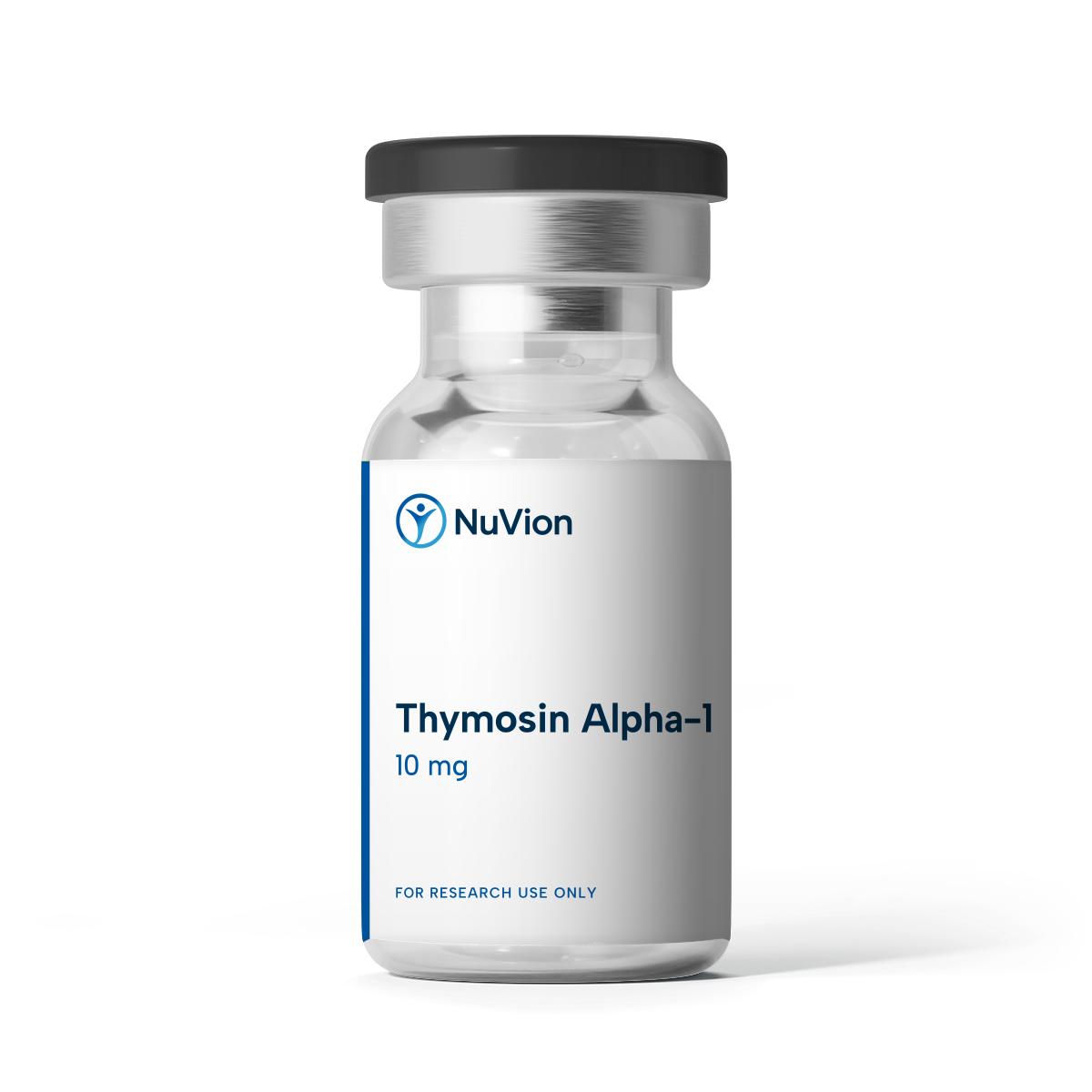
Thymosin Alpha-1, Thymulin and Thymogen are all named for the thymus, and that is most of what they have in common. They are three unrelated peptides of very different sizes. Thymosin Alpha-1 has 28 residues, Thymulin has 9 and needs zinc to be active, and Thymogen is a dipeptide. This page compares their structure and laboratory use.
At a glance
| Thymosin Alpha-1 | Thymulin | Thymogen | |
|---|---|---|---|
| Length | 28 amino acids | 9 amino acids | 2 amino acids |
| Sequence feature | N-terminally acetylated, residues 1 to 28 of prothymosin alpha | pGlu-Ala-Lys-Ser-Gln-Gly-Gly-Ser-Asn | Glu-Trp |
| Metal dependence | None | One zinc ion per molecule | None |
| Also known as | Thymalfasin | Serum thymic factor (FTS) | Oglufanide |
| Common cell models | Dendritic cell and T-cell cultures | Thymocyte and T-lymphocyte cultures | Cell-based innate immune assays |
| NuVion vial size | 10mg | 10mg | 20mg |
Structure
Thymosin Alpha-1 is the largest of the three. It is the first 28 residues of the protein prothymosin alpha, with an acetyl group on its N-terminus, and it carries a strong negative charge from its many glutamate and aspartate residues.
Thymulin is a nonapeptide that begins with pyroglutamate and is produced by the epithelial cells of the thymus. On its own it is inactive. It binds one zinc ion per molecule, and the zinc-bound form is the active one. Thymogen is simply two amino acids, glutamate and tryptophan, joined by an ordinary peptide bond.
Mechanism at the cell level
Because the three are structurally unrelated, they are studied through different endpoints. Thymosin Alpha-1 is used in dendritic cell and T-cell culture in work on Toll-like receptor signalling and cytokine expression. Thymulin is used to study zinc binding and T-cell differentiation markers. Thymogen is used as a defined dipeptide stimulus in assays of pattern-recognition receptor expression and cytokine secretion.
Where each is used in research
- Thymosin Alpha-1: Toll-like receptor signalling and cytokine expression assays
- Thymulin: zinc binding studies and T-cell differentiation assays
- Thymogen: dipeptide transport and peptidase stability experiments
- All three: comparisons of thymus-derived signalling peptides in immune cell cultures
Supplied by NuVion
NuVion stocks all three in Australia as lyophilised vials: Thymosin Alpha-1 in 10mg, Thymulin in 10mg and Thymogen in 20mg. Thymosin Alpha-1 is also sold with LL-37 as the Immune Signalling Pair. Published certificates are shown on each product page and in the COA library.
Frequently asked questions
Is Thymulin the same as Thymosin Alpha-1?
No. Thymulin is a 9-residue peptide that needs zinc to be active. Thymosin Alpha-1 is a separate 28-residue peptide with no metal requirement.
Is Thymosin Alpha-1 related to TB-500?
Only by name. TB-500 is a fragment of thymosin beta-4, an actin-binding protein with a different sequence. The two are compared with their neighbours in BPC-157 vs TB-500.
Are these products therapeutic goods in Australia?
No. NuVion’s Thymosin Alpha-1, Thymulin and Thymogen are laboratory chemicals for in vitro research. They are not included in the Australian Register of Therapeutic Goods, have not been assessed by the Therapeutic Goods Administration, and are not for human or veterinary use.
Research use only. These products are laboratory chemicals supplied for in vitro research. They are not included in the Australian Register of Therapeutic Goods and have not been assessed by the Therapeutic Goods Administration for quality, safety or efficacy. They are not for human or veterinary use, and nothing on this page is a representation about therapeutic use.