
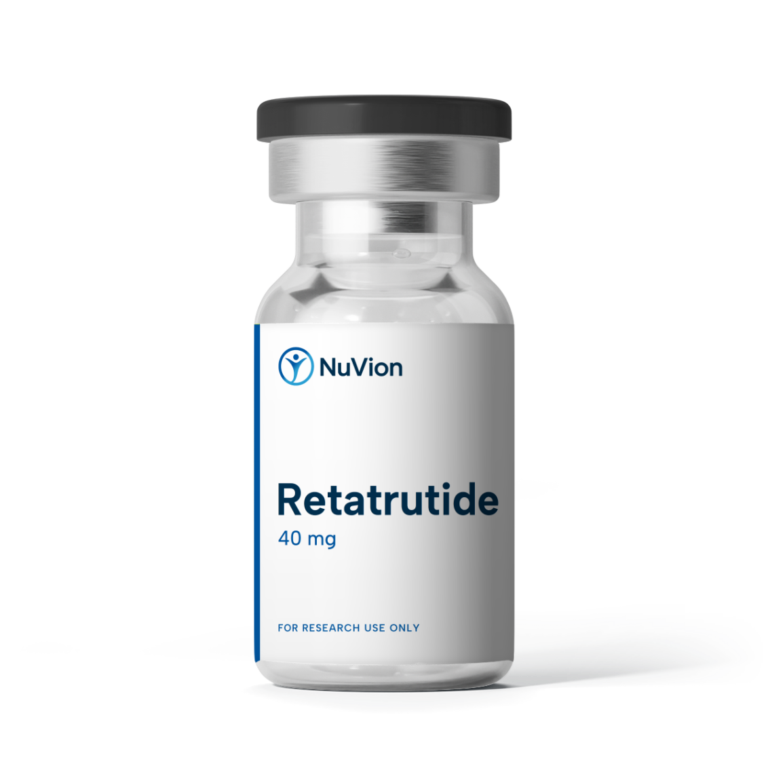
Retatrutide, Tirzepatide and Cagrilintide are long-acting lipidated peptides used as reference compounds in metabolic receptor research. The difference between them is which receptors they activate. Retatrutide is an agonist at three, Tirzepatide at two, and Cagrilintide acts on a separate receptor family altogether. This page compares them at the molecular level only.
At a glance
| Retatrutide | Tirzepatide | Cagrilintide | |
|---|---|---|---|
| Receptors | GLP-1R, GIPR and GCGR | GLP-1R and GIPR | AMY1R, AMY2R, AMY3R and the calcitonin receptor |
| Class | Triple incretin and glucagon agonist | Dual incretin agonist | Amylin analogue |
| Length | 39 amino acids | 39 amino acids | 37 amino acids |
| Lipidation | C20 fatty diacid side chain | C20 fatty diacid side chain | C20 fatty diacid side chain |
| Also written as | LY3437943 | LY3298176 | Acylated amylin analogue |
| NuVion vial sizes | 10mg to 60mg | 10mg and 60mg | 10mg |
Structure
Retatrutide and Tirzepatide are both 39-residue peptides with an amidated C-terminus, and both carry a C20 fatty diacid attached through a linker to a lysine side chain. The fatty acid binds albumin in solution, which is what makes each of them long acting. Their backbones differ in the residues that decide receptor preference.
Cagrilintide comes from a different parent. It is built on the 37-residue sequence of human amylin, with an N-terminal disulfide loop, an amidated C-terminus and the same kind of fatty diacid side chain.
Mechanism at the receptor level
The GLP-1, GIP and glucagon receptors are class B G protein-coupled receptors that signal through Gs and cyclic AMP. Tirzepatide activates the first two. Retatrutide activates all three, which adds the glucagon receptor arm. Cagrilintide does not bind any of them. It is an agonist at the amylin receptors, which are the calcitonin receptor paired with a receptor activity-modifying protein, and at the calcitonin receptor itself.
Where each is used in research
- Retatrutide: cyclic AMP assays across GLP-1R, GIPR and GCGR in transfected cell lines
- Tirzepatide: reference compound for dual incretin receptor signalling
- Cagrilintide: receptor binding and second messenger assays at amylin and calcitonin receptors
- All three: comparisons of receptor selectivity and albumin binding among lipidated peptides
Supplied by NuVion
NuVion stocks all three in Australia as lyophilised vials: Retatrutide in seven sizes from 10mg to 60mg, Tirzepatide in 10mg and 60mg, and Cagrilintide in 10mg. Published certificates are shown on each product page and in the COA library. Each compound has its own profile in the research library: Retatrutide, Tirzepatide and Cagrilintide.
Frequently asked questions
What is the difference between Retatrutide and Tirzepatide?
One receptor. Tirzepatide is an agonist at the GLP-1 and GIP receptors. Retatrutide is an agonist at those two and at the glucagon receptor.
Is Cagrilintide a GLP-1 agonist?
No. Cagrilintide is an amylin analogue and acts at the amylin and calcitonin receptors. It has no activity at the GLP-1 receptor.
Are these products therapeutic goods in Australia?
No. NuVion’s Retatrutide, Tirzepatide and Cagrilintide are laboratory chemicals for in vitro research. They are not included in the Australian Register of Therapeutic Goods, have not been assessed by the Therapeutic Goods Administration, and are not for human or veterinary use.
Research use only. These products are laboratory chemicals supplied for in vitro research. They are not included in the Australian Register of Therapeutic Goods and have not been assessed by the Therapeutic Goods Administration for quality, safety or efficacy. They are not for human or veterinary use, and nothing on this page is a representation about therapeutic use.